

Outline
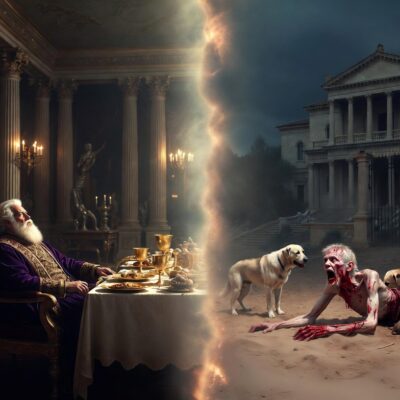
I. Confront the Ugly Chasm of Inequality Fueled by Sin The parable thrusts us into the raw clash between the filthy-rich man clothed in purple and fine linen who partied every day and the desperately poor Lazarus, full of sores, begging for crumbs at his gate—proving that greed, selfishness, pride, and laziness will always breed haves and have-nots. Any attempt to fix inequality that ignores sin’s root is doomed; only gospel-transformed hearts can show true mercy and justice.
II. Unmask the Selfish Indifference That God Will Judge The rich man stepped over suffering Lazarus daily yet hoarded every comfort, refusing even the crumbs that fell from his table—exposing how easily we too prejudge the beggar, addict, or ex-con as “undeserving.” What we do in this life matters eternally: compassion to the least of these is compassion to Christ, and God will demand an account.
III. Brace for Death—the Great Equalizer That Ends All Chances Both men died—the beggar carried away, the millionaire buried—revealing that wealth cannot buy one extra day and that death seals every choice with no do-overs. Regrets become permanent; the life we live now is the only life we get to shape our eternity.
IV. Witness Eternity’s Shocking Reversal: Comfort for the Afflicted, Torment for the Selfish Angels carry the broken Lazarus to Abraham’s bosom—the place of honor, healing, and eternal fellowship—while the rich man awakens in Hades, tormented in flames, seeing bliss he can never reach. Hell is conscious, horrible suffering; heaven is perfect rest for those God helps.
V. Tremble Before God’s Fixed Justice and the Uncrossable Gulf Abraham declares the great reversal: “You received your good things; Lazarus received evil things—but now he is comforted and you are tormented,” with a fixed gulf no one can cross. God’s justice will be satisfied—comforting the faithful poor forever and punishing the unmerciful forever.
VI. Heed the Sufficient Word and Repent Today When the rich man begs for a sign to warn his brothers, Abraham replies that Moses and the Prophets are enough—if they won’t listen to Scripture, they won’t be persuaded even if one rises from the dead. The time to believe, show mercy, and live for Christ is now; death closes the door with no second chance.
Bottom line: Heed God’s Word and show mercy today—or join the rich man in the flames forever, for death fixes your eternal fate.
Scripture Reading
Luke chapter 16 and we’re looking this afternoon at verses 19 through verse 31. So listen now to the reading of God’s holy word.
“There was a certain rich man who was clothed in purple and fine linen and fared sumptuously every day. But there was a certain beggar named Lazarus, full of sores, who was laid at his gate. desiring to be fed with the crumbs which fell from the rich man’s table.
Moreover, the dogs came and licked his sores. So it was that the beggar died and was carried by the angels to Abraham’s bosom. The rich man also died and was buried. And being in torments in Hades, he lifted up his eyes and saw Abraham afar off and Lazarus in his bosom.
And then he cried and said, Father Abraham, have mercy on me. and send Lazarus that he may dip the tip of his finger in water and cool my tongue, for I am tormented in this flame. But Abraham said, Son, remember that in your lifetime you received your good things, and likewise Lazarus his evil things. But now he is comforted, and you are tormented. And besides all this, between us and you there is a great gulf fixed. so that those who want to pass from here to you cannot, nor can those from there pass to us.
Then he said, I beg you, therefore, father, that you would send him to my father’s house, for I have five brothers that he may testify to them, lest they also come to this place of torment. And Abraham said to him, they have Moses and the prophets, let them hear them. And he said, No, father Abraham, but if one goes to them from the dead, they will repent. But he said to him, If they do not hear Moses and the prophets, neither will they be persuaded, though one rise from the dead.”
OPENING PRAYER
Gracious God in heaven, we do praise you and thank you once again that we have this opportunity to come to consider the truth of your word, and we pray that you’d open our hearts, ears, and our minds to hear your truth by the power of your spirit, and that you’d richly and abundantly bless your word, and that it would truly not return void, but accomplish the purpose in us for which you intend, all to the praise of your glorious name. In Jesus’ name we pray, amen.
INTRODUCTION
Well, in our passage this afternoon, we come to the parable of the rich man and Lazarus. Though in the context of Luke chapter 16, Jesus has been dealing with the theme of wealth, we’ll see that this parable addresses much more, though, than just wealth. It does deal with it a little bit and how to handle wealth, but it also gives us many other lessons especially about this life, about the life to come, and even about the gospel.
THIS LIFE — LESSON ONE: INEQUALITY DOES EXIST
First in regards to this life, we learn from this parable that inequality does exist.
That is, there will always be rich and poor, the haves and the have-nots. This is what Jesus confirms in Matthew 26. He says, for you always have the poor with you. And of course, if the poor are always with us, then it goes without saying that the rich will also always be with us.
And again, we see this inequality very graphically depicted before us in verses 19 to 21. Consider this comparison.
- One man who was not only rich, but he was filthy rich, we might say, lacking nothing
- The other man was desperately poor to the point of having to beg for food
- One man was inside his luxurious house with every comfort imaginable, while the other man was left outside the gate, exposed to the elements
- One man is dressed in purple and fine linen, just like a king, and we’re told that the other man was clothed in sores and open wounds
- One man lived in splendor every day, and the other man lived every day in pain and suffering
- One man had an abundance of food and drink, and the other man longed to have even the crumbs that fell from the rich man’s table
- One man likely had several servants fulfilling his every need. And the other had only the mangy wild dogs to lick his wounds
And so the differences between these two men show this huge chasm of inequality in their lifestyles.
Why is this? Why is there such socioeconomic inequality even today? And people have that question and they look for solutions. Well, ultimately we know It’s the result of sin. Sins like greed, selfishness, pride, hate, laziness, these are all sins that will feed into the socioeconomic inequality that is present in the world. And until sin is completely eradicated in the nature of mankind, we know then that such inequalities will continue to exist.
This is significant because any and all attempts to deal with this problem that do not first acknowledge and address the issue of sin We know we’ll be doomed to fail.
Now, this doesn’t mean that we shouldn’t do anything to help and assist the poor and equip them to improve their standard of living. And it doesn’t mean that we shouldn’t condemn greed, hatred, and injustice when we see it, whether it’s in ourselves and others, in corporations or in governments. As believers in Christ, we are called to minister to the poor and needy. and extend peace and justice throughout the world. But these efforts must be centered in the gospel of Jesus Christ, the gospel of grace that transforms the human heart through repentance, forgiveness of sins, and walking in holiness and truth before God.
Only with such transformations of the heart will socioeconomic inequality ever be overcome. But even then, because we know that sin will still exist in the world, there won’t be a complete end to this inequality until ultimately Christ returns at the end of the age.
And so we learn from this parable that we shouldn’t be surprised when we see such inequalities. They do exist. And whether we find ourselves on the richer end, or the poorer end, or somewhere in the middle, we’re all called to be conformed to the image of Christ, showing mercy and kindness, and seeking truth and justice through the gospel of grace.
THIS LIFE — LESSON TWO: SELFISH INDIFFERENCE WILL BE JUDGED
And so this is exactly, though, what this rich man in this parable was not doing. The rich man daily dressed himself up as if every day was a party. He gloried in his wealth and all the comforts that it provided. He even seems to have publicly even flaunted his wealth so that everyone else would be in awe of him. but he kept it all to himself. He was a selfish lover of money who gave no thought to the needs of others.
Even though every time that he would go in and out of his house, he would pass poor Lazarus, who was clearly suffering. The lesson we learn here is that what we do in this life and how we live our lives truly does matter in God’s sight. And He will require an account from us on the last great day.
The rich man was so enraptured with himself and his wealth that he couldn’t and wouldn’t see the needs of those around him, yet all the means necessary to greatly alleviate the suffering of this man who laid outside his gate. He could have given him food, clothing, shelter, medical care, even a bath out of great abundance.
He had all the great abundance that he had, and yet the implication is that this rich man didn’t even give Lazarus the crumbs that would fall from his table. Now maybe he thought Lazarus was a bum, a lazy man who refused to work for a living, or maybe he was a criminal, or because he had all these sores, certainly it seemed as though God was punishing him for some sin. If that were the case, then the rich man had judged the beggar and had declared him undeserving of even the smallest shred of kindness.
But it’s not just the rich man or the scribes and Pharisees as Jesus is likely saying this parable in their hearing for their benefit. But it can also apply to us. Have we ever been guilty of the same sin of declaring someone unworthy of compassion or kindness because of how they look or what they were doing or something that they’ve done? Have we prejudged someone and refused to show even some basic kindness to a beggar on the street or a drug addict or an ex-con or someone who is caught up in some sinful lifestyle? It certainly is worth examining our hearts.
But why? Why is this so important? Because compassion and mercy are important to God. and he’ll require us to give an account on the last great day.
“The writer of the Hebrews charges in Hebrews 13, do not forget to entertain strangers, for by doing so, some have unwittingly entertained angels.”
And then Jesus makes it even more pointed in Matthew 25, saying, to the extent that you didn’t show some kindness or compassion or mercy to one of the least of these, you did not show it to me.
And so in his selfishness, the rich man wasn’t showing kindness to Christ. And he may have even been shunning an angel or one of God’s holy ones.
And one of the unique features of this parable is that the beggar here is actually named. We know his name is Lazarus. Jesus is telling this parable, but he names this man Lazarus. Lazarus, the name means the one whom God helps. Now is it possible that Jesus gives the beggar this name because he was truly a child of God? He’d been helped by God’s grace? It’s very possible. Especially when we see where he ends up.
But then in contrast, you have the rich man. Though he had everything, he doesn’t have a name. Clearly Jesus knows the names of those who are His. He calls them by name, and they hear His voice, and they come to Him. But the name of this rich man isn’t uttered from the lips of Jesus, because he wasn’t serving Christ and the glory of God in his life. And so, yes, it matters very much to God whether we’re living for ourselves or for His glory in our lives.
THIS LIFE — LESSON THREE: DEATH COMES TO ALL
A third lesson we learn about this life is that sooner or later, death comes to each and every one of us.
In verse 22, the poor man died. And, of course, this is no surprise considering his health and poverty and lack of adequate nourishment. It was certainly only a matter of time. But in the very same verse, despite all his wealth and riches, we’re told that the rich man died also. His wealth couldn’t buy him life.
And we know this is the great tragedy of many even today. Many who accumulate money and wealth and who trust in that to keep them alive, to help them look younger and live longer. But it’s all for naught. because it’s been appointed for everyone to die once. And then comes the judgment. Death is the great equalizer. It’s the ultimate curse of sin. And once death comes, that’s it. Everything’s gone.
You can’t take your wealth with you. There’s no turning back. If you didn’t do something, It will remain undone. And if you did do something, then you can’t go back and change it. Regrets become set in stone, unchangeable. There are no second chances.
And so this then should challenge us to live our lives in ways that will make a difference and have an impact for the good of others and ultimately for the glory of God. Because in this life, we know that death is final. But just because death is final, doesn’t mean that death is the end. Because there is a life to come. An eternal life that goes on and on. And one of the reasons why what we do in this life matters is because it greatly then affects what happens to us in this eternal life to come.
THE LIFE TO COME — HEAVEN
And so what do we discover in this parable about this life to come? First, we consider what happened to Lazarus. We see the reality of heaven and the eternal rest in God’s glorious presence for those who trust in Him.
Now when Lazarus dies, we’re told that he’s met by ministering angels who come and who actually carry him to Abraham’s bosom. Abraham’s bosom, though not in a literal place, is a figurative way to speak of being in a place of blessing and honor. To be at the bosom or the side of the host at a dinner party was to be in a place of honor. And so the picture given here is that Lazarus, who was denied comfort and blessing in this life, is now seated at a glorious banquet with Father Abraham.
Abraham, remember, was not only the physical father of Israel, but he also was upheld as the father of the true Israel of God. That is, those who are of the community of faith in Christ. This is what Paul says in Galatians 3, And if you belong to Christ, then you are Abraham’s seed, and heirs according to the promise. So this place of eternal blessing and honor is where we find Lazarus.
And note, all his pain and his suffering is gone. He’s been perfectly healed and he enjoys the fellowship of Abraham and all the saints in God’s glorious presence.
THE LIFE TO COME — HELL
But we not only learn of the reality of heaven and eternal bliss, we also see here in this parable the reality of hell and eternal torment. And this is where we find the rich man, the one who had everything in this life and who selfishly and shamefully kept it to himself. He wasn’t generous. He wasn’t compassionate. He wasn’t kind toward the poor and not faithful to God and the gospel. And so it’s a grand turn of events.
Hades, as is mentioned here, is often a note in the scripture as simply being the place of the dead. It’s important to keep in mind, and it’s a word that’s used in both the Old Testament and as well as the New Testament, but in the New Testament when it’s used, when the word Hades is used, it never refers to the place where the righteous go. Therefore, it’s a clear reference in the New Testament to hell.
We learn here that hell is a place of conscious torment. That is, the rich man is aware of what’s going on around him, and thus, there’s no soul sleep, there’s no annihilation, as some contend. But it’s a conscious awareness. We learn hell is a place of great suffering and pain.
And again, look at how Jesus describes it. He says, being in torment, that he’s far off from Abraham’s bosom. He’s able to see the bliss of Abraham’s bosom, but he’s not able to enjoy it. He cries out for mercy, desiring even a small taste of relief from the torment in this flame. And then again in verse 25, he’s in torment.
And there’s a great chasm is set between heaven and hell that’s uncrossable from either side. And then in verse 28, again, he’s in a place of torment. What a horrible graphic picture is given to us here. And yet this is the reality of hell. Fire, flames, pain, suffering, torment, and separation from God to which there is no end.
Do I need to remind you that this is Jesus speaking and describing this awful place? And again, you know, people today like to deny hell and even claim, some who claim the name of Christ, and yet Jesus is the one who speaks most frequently in the scriptures about hell. He speaks about it more than anyone. And the description he gives is much more detailed than any description we have of heaven. Hell is real. Hell is horrible. Hell is for those who reject Christ and the gospel and who don’t strive after holiness, justice, and truth in this life.
THE LIFE TO COME — GOD’S JUSTICE PREVAILS
But we also learn in this parable that God’s justice surely does prevail. The rich man pleads to Abraham for even a small taste of mercy, but there’s no mercy in hell. It is the place of eternal punishment. It’s the place for God’s justice to be meted out against the unrighteous.
Note Abraham’s response in verse 25.
“Son, remember that in your lifetime you received your good things and likewise Lazarus evil things, but now he is comforted and you are tormented.”
The rich man had everything in this life. Lazarus didn’t have anything. But now, because of God’s justice, The roles are reversed. The rich man has nothing and is desperate, and Lazarus is comforted with the abundance of God’s blessing and goodness.
Note here that Abraham doesn’t speak rudely to the rich man, but neither does he give him words of false comfort. He just plainly speaks the very truth. The rich man lived his life for a reward that wouldn’t last. that would quickly pass away. And when he had even the opportunity set right before him at his own gate to minister mercy and compassion in the name of the Lord, he refused.
In God’s justice, he’s now getting what he deserves. But we also see the justice of God, not only in the punishment of the wicked, but also in the comfort of the poor and needy. You see, God is mindful of His people, even though they may be poor and needy, sick and afflicted, in pain and suffering, persecuted and oppressed. God is just, and He will comfort us with an eternal comfort. He’ll provide for all our needs. He’ll never leave us nor forsake us, not in this life and most certainly not in the eternal life to come. Of this, friends, we can be sure.
THE GOSPEL
Well, we’ve seen the lessons in this parable for this life and the lessons for the life to come, but what does this parable now teach us about the gospel? We find this in the exchange between Abraham and the rich man in verses 27 to 31.
And the first thing we learn is that the word of God alone is sufficient for salvation. The rich man, realizing he’ll get no relief and that he deserves no mercy, he suddenly seems to have some sense of compassion. And so he then asks Abraham, saying, well, send Lazarus to my father’s house, because I’ve got five brothers. And let Lazarus testify to them, lest they also come to this place of torment. But even in this request, We see that his compassion is extremely limited only to those in his own family. He doesn’t say, hey, send Lazarus back to tell everyone that they might be delivered from this torment. No, he still ultimately is still focused upon himself.
But Abraham responds, well, look, they have Moses and the prophets. Let them hear them. And this is the same as the Law and the Prophets and as a way to speak in summary of the whole Old Testament Scriptures.
And it’s important that we understand that even these Old Testament Scriptures are sufficient for salvation. This is the very thing that the Apostle Paul declares to Timothy. 2 Timothy 3, 15, that from childhood you have known the Holy Scriptures, which are able to make you wise for salvation through faith, which is in Christ Jesus. The only scriptures available at the time were Moses, the Psalms, and the Prophets. And if these were sufficient, well then how much more so the Gospel and the New Testament scriptures.
The Word of God by the power of the Holy Spirit is able to pierce the heart of sinful man, convict of sin, convert to Christ, and show the way of truth and holiness. They’re certainly sufficient to lead sinners to salvation. and keep them from the eternal torments of hell. That is, they’re sufficient and effective to the end if they’re read, heard, and obeyed, and not cast off and ignored, like the rich man apparently did during his lifetime.
But the rich man didn’t see the value of the Scriptures. In fact, even now, at this time, he misses it, and so he protests to Abraham. He says, no, Father Abraham, but if one goes to them from the dead, they will repent. And so he denies the sufficiency of God’s word to save sinners and instead believes that some dramatic sign is needed and necessary in order to convince his brothers. Well, sign seekers, we know, should beware.
Abraham rebukes him. If they do not hear Moses and the prophets, neither will they be persuaded, though one rise from the dead. In other words, if they won’t listen to the simple truth proclaimed in the gospel, but they harden their hearts against it, then they’re certainly not going to believe something extraordinary, even if the dead would rise and preach to them. For the risen dead wouldn’t preach anything to them that isn’t already found in the Scriptures.
And so, to this greater sign, they’re only going to further harden their hearts. The very truth of this point would become reality, we know, because the dead would rise. First, the real life Lazarus, the friend of Jesus, and then, of course, Jesus himself would rise from the dead. Did the scribes and Pharisees believe and repent? No, not at all. In fact, they dug in their heels in unbelief, and at least with Lazarus, they even plotted to put Lazarus to death again. After he had been raised from the dead, they wanted to kill him, put him back in the grave. Their hard hearts wouldn’t listen to Moses and the prophets about Christ. They wouldn’t listen to the gospel that Jesus proclaimed, and their hearts only hardened more when someone undeniably rose from the dead.
Well, this continues to be a problem we know even today, because there are many sign seekers. And you hear people talk and, you know, different atheists say, well, if God would just reveal himself, People aren’t satisfied with the simple proclamation of the gospel and the word of God. They demand something more, something entertaining or more dramatic before they would believe. They want a sign. Even someone returning from the dead to declare to them the truth. But the reality is if they won’t believe what is simple and sufficient, they will never believe at all.
Until the final point we learn from this parable, and from the gospel, is that the time to respond to the gospel is now. There’s no better time than now. The time to repent of your sin and believe in Christ for salvation is now. The time to strive to live righteous and holy lives is now. The time to be gracious, merciful, and compassionate is now. Don’t wait for a miracle or for some blinking neon sign appearing in the sky to believe. You have the gospel proclaimed to you, even now. So now is the time to respond.
Because when death comes, and it will come to everyone at some point, when death comes, it will be too late. Too late to respond. Too late to repent. Too late to live for Christ and His glory. There will be no second chance once death has come. There will be no second chance at all.
Today is the day of salvation. And those who call upon the name of the Lord in faith will indeed be saved and the treasure of eternal life in God’s glorious presence forever and ever will be yours. And so truly by the grace of God, grab hold even now of these truths and believe that God may be glorified in the salvation of his people.
CLOSING PRAYER
Gracious God in heaven, we do rejoice and give thanks for your blessing, for your word, for this important reminder that truly what we do in this life does matter and it has great impact. And that we have given to us the simple message of the gospel. We have it proclaimed. We have heard it. We trust that your spirit gives us understanding and insight. and that you help us quicken our hearts to believe it and to embrace it as truth.
And so, Father, we just praise you and thank you for this revelation of your truth, for this encouragement, and that you would help us to be walking in truth and righteousness, that we might be a witness to those around us, that we might be those beacons of light and hope, proclaiming your gospel. We know that there will be many, many who will ask for a sign and for some great evidence. And we know that if they do not believe just the simple truth, they will never believe, even if someone were to rise from the dead. Because someone has risen from the dead, even Christ our Lord, and yet they still reject Him. And so, Father, we just pray that you would impress these truths upon each of our hearts, drawing us all closer to yourself. In the name of the Lord Jesus Christ, we pray. Amen.