

Scripture Reading
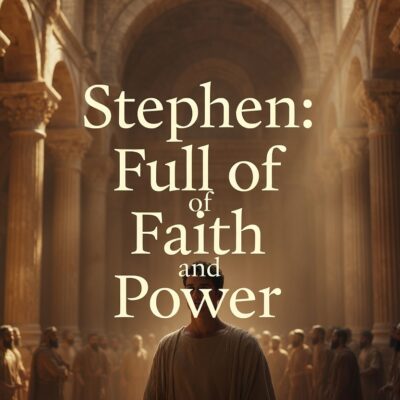
And Stephen, full of faith and power, did great wonders and signs among the people. Then there arose some from what is called the synagogue of the freedmen, Assyrians, Alexandrians, and those from Cilicia and Asia, disputing with Stephen.
And they were not able to resist the wisdom and the spirit by which he spoke. Then they secretly induced men to say, We have heard him speak blasphemous words against Moses and God. And they stirred up the people and the elders and the scribes, and they came upon him, seized him, and brought him to the council. They also set up false witnesses, who said, This man does not cease to speak blasphemous words against this holy place and the law. For we have heard him say that this Jesus of Nazareth will destroy this place and change the customs which Moses delivered to us. And all who sat in the council, looking steadfastly at him, saw his face as the face of an angel.
Opening Prayer
O gracious God in heaven, we do praise you and thank you again that we are so wonderfully privileged to once again come to worship you and to call upon your name, to open your word, and to learn and to receive the truth that you have for us. And so we pray, Father, that you would be with us this evening as we come to this passage, and that you would give us insight and understanding by the power of your spirit, and that you would richly and abundantly bless your word and our hearts, all to the praise of your glorious name. We ask now for your blessing upon your word. In Jesus’ name we pray, amen.
Introduction: A Time of Great Transition
Well, it was a time of great transition for the church, as we have considered thus far in the study of the Book of Acts. There’s been this exponential growth through the outpouring of the Holy Spirit and, of course, the faithful preaching and teaching of the apostles, which continued even in the midst of opposition opposition that they face from outside, from the Jewish religious leaders, as well as opposition from inside.
And remember the account of Ananias and Sapphira, and then of course just before this, there was the potential disruption to the peace and unity of the church with the dispute about the care of the widows. Remember that this recent problem from within was resolved with the selection and ordination of seven men to serve as the first deacons. We read back in verse 7, that the word of God spread and the number of the disciples multiplied greatly in Jerusalem. and a great many of the priests were obedient to the faith. And so again, the Lord was blessing the church after this challenge to the peace and unity of the church. They appointed these seven deacons and there was again a further expansion. But one of the things that is especially notable here is that some of those who would have formerly opposed the apostles, the priests, had now actually joined with them as they had come to believe in the gospel and in the Lord Jesus Christ as the promised Messiah.
Again, this was a Duranic turnaround, but Luke now takes a bit of a break from sharing about the ministry of the apostles. to now spending some time sharing about the ministry of some of these newly ordained deacons. What we quickly discover is that some of the deacons, having already been filled with the Holy Spirit, quickly show that their gifts go far beyond merely serving tables. As we see here in verse 8, that Stephen, full of faith and power, did great wonders and signs among the people.
Stephen’s ministry in the spirit involved even doing great wonders and signs, even similar to those that were being done by the apostles who of course were following and doing the same miracles and even more so that Jesus was doing. And of course from what follows, We also gather here that Stephen exhibits great gifts for teaching as he takes opportunity here to expound the gospel in the hearing of the people. Now certainly the apostles would have been delighted then to see that one who had been actually chosen from the people, remember those seven deacons were chosen from among the people, that they were greatly gifted for the work of the ministry. And Stephen diligently used his gifts here to serve the Lord. And knowing what had already happened to Peter, to John, and to the other apostles, we know that Stephen likely knew that sooner or later he was going to face opposition as well.
The Rise of Opposition
Well, this opposition perhaps comes much sooner than he expected. And it comes from a very different source than what the opposition has come previously. And we see this in verse 9, that there arose some from what is called the synagogue of the freedmen, Cyrenians, Alexandrians, and those from Cilicia and Asia, and they were disputing with Stephen.
Now not much is known about this synagogue of the freedmen. The implication would be that it was a congregation of Jews who had possibly been enslaved by the Romans or others in various places, but of course they were now free. And so seeking to build a community around a common experience, they just sort of started their own synagogue where they could all gather together and worship. Now we don’t know for certain, but what we do know is that given the nationalities of those who attended this synagogue, is that these were likely Hellenistic Jews.
That is, those who were native to the regions where the Jewish people had been dispersed during the Assyrian and then especially the Babylonian captivity several hundred years before. And so they were coming from all over the Mediterranean region. Cyrene and Alexandria were cities in northern Africa and Cilicia and Asia were likely references to Asia Minor, which is today modern-day Turkey. Now note that all these captives, or of course not all those that who were exiled to these faraway places, not all of them returned to Judea after the exile.
But it seems that they may have organized their own synagogue in Jerusalem so that whenever they would come to town to attend and take part in the feast days, that they again would have this opportunity to fellowship with those that they had this common bond with, having been previously enslaved.
And so it was these Hellenistic Jews who now were joining in the opposition to the teaching of the gospel. And again, this is somewhat noteworthy because previously it was Judean Jews rising up in opposition to Judean Jewish believers like Peter, John, and the other apostles. But now, after the crisis involving Judean Hellenistic Jewish widows in the church and the appointment of seven Hellenistic believers to the office of deacon, we are now seeing Hellenistic Jews rising up in opposition to these Hellenistic believers.
In other words, as the Gospel spreads to people of every nation, We also are seeing that the opposition is also expanding and spreading to include people from every nation. And of course, this trend we know will continue as the gospel will continue to spread beyond those who are born Jews to those who were born pagan Greeks and Romans. And so we know as the gospel continues to spread, that opposition even from those sources, from those Greek and Roman sources, is also going to increase, or the Gentile lands we might want to say as well. So the great lesson that we need to take note of here is that wherever the gospel spreads, among whatever nation, tribe, or tongue of people… the opposition to the gospel will always be present, and it will also spread as the gospel spreads.
We know that darkness and the world that we live in is in darkness, spiritual darkness, as opposed to light. And whenever the light shines, the darkness will try to snuff it out. But we know that the light of the gospel will triumph ultimately and will march on even as it has for over 2,000 years.
Stephen Overcomes the Dispute
Well, here these Hellenistic Jews begin to argue with Stephen about the gospel. But as they do so, they quickly realize that they’re overmatched.
In verse 10, and they were not able to resist the wisdom and the spirit by which he spoke. They were unable to resist. That is, they couldn’t defend themselves against the wise words that Stephen spoke. Now, this wasn’t necessarily because Stephen was necessarily a great persuasive speaker who waxed eloquently. Indeed, he very well may have been. But the reason that we’re given here is because the Holy Spirit was with Stephen, empowering him, giving him words to speak.
Now this would be similar to what the Apostle Paul would later say about the ministry of preaching in 1 Corinthians 2. Paul says that now we have received not the spirit of the world, but the spirit who is from God, that we might know the things that have been freely given to us by God. These things we also speak, not in words, which man’s wisdom teaches, but which the Holy Spirit teaches, comparing spiritual things with spiritual. But the natural man does not receive the things of the Spirit of God, for they are foolishness to him, nor can he know them, because they are spiritually discerned.
So these Hellenistic Jews were using just the mere words of men and the wisdom of men, but Stephen was guided by the wisdom of the one true living God who has created all things and who knows all things. The spirit is no match then for, the spirit is infinite and eternal and these Hellenistic Jews were way out of the leagues. They were no match for the work of the spirit of the living God. They couldn’t counter Stephen’s arguments because again Stephen spoke with spiritual authority of the things that could only be spiritually discerned. And these Hellenists lacked the discernment. that the Holy Spirit provides, and so they were just simply stumped and silenced.
From Debate to Deception
But, as often happens, and you may experience this, even today, when people engage in discussion and debate, and one side perhaps begins to fear that they’re starting to lose the debate, and they’re being outdone by the other opponent, Well, they quickly go from the words and wisdom and reason to leaving that realm and any sense of humility that their opponent may actually be speaking the truth.
And they set out on personal attacks and attacks and deceptive tactics. And this is what these Hellenists do here in verse 11. Then they secretly induce men to say, we have heard him speak blasphemous words against Moses and God. And they stirred up the people, the elders and the scribes, and they came upon him, seized him, and brought him to the council.
And so they induced others to falsely accuse Stephen and say that he had spoken blasphemy against God and against Moses. Now, both of these charges, Stephen will, as we’ll later see in his defense in chapter 7, that they were false. But from what’s charged against him in verse 14, it appears as though Stephen was likely proclaiming how Jesus had simply come in fulfillment of the Scriptures. This is what Peter has been doing up to this point, showing from the Scriptures how Christ Jesus has come in fulfillment of them, and that because He has come, that there would no longer be the need for a sacrifice. since he was the once for all perfect sacrifice for sins.
While making this false charge, they further stirred up the people, working them up kind of into a frenzy. And this is kind of an interesting thing to think about because that never seemed to be very difficult to do. Whether it was earlier with Jesus himself, the religious leaders stirred up the crowds earlier that morning so that they shouted, crucify him, crucify him. And of course, on numerous occasions with the Apostle Paul, the people always seem to be kind of on edge and just ready to riot with very little prompting.
And that’s what we see is going on here. But the opposition, again, is successful in certainly stirring up the crowds. And so they seized Stephen, and they carried him away to stand before the council. Now, again, we note that this was the same council that previously opposed Peter and John. And yet, remember how they, on the most recent occasion, they let them go based on the advice of Gamaliel.
Here, the Hellenistic Jews, well, they seem to be even more aggressive and bloodthirsty than their Judean counterparts. And since Stephen is a Hellenist, Well, his hometown Judean court may not be as lenient toward him as they were toward the Judean Jewish believers like Peter and John.
False Witnesses Before the Council
So before the court, the false witnesses again come forth. Verse 13, This man does not cease to speak blasphemous words against this holy place and the law. For we have heard him say that this Jesus of Nazareth will destroy this place and change the customs which Moses delivered to us. And here we want to note a few things. First, the charge of blasphemy is found in Stephens. This is what they’re charging.
He’s saying blasphemy because it’s his supposed speaking against this holy place, meaning the temple and the law. Now, the temple, we remember, was the dwelling place of the Lord. And so speaking against the temple was, in essence, speaking against the Lord himself, who dwelt there. And the same would be the same. regarding the law.
Disregarding the law which the Lord has given would be blasphemy against the Lord himself, since he is the supreme lawgiver. that Stephen was most likely declaring how Jesus had come as the promised Messiah in fulfillment of the scriptures. And how he had fulfilled really the demands and the requirements of the law, implying as well that the temple worship would now be done away with because of the sacrifice of Jesus. Now this of course we know was certainly true and God would assure that it was the truth when in 70 AD he had the temple destroyed and still it has never yet been rebuilt. The sacrificial system was now null and void because of Christ’s once for all perfect sacrifice. But of course these false accusers certainly didn’t believe that.
And they only saw this as here knowing, they say this knowing that it would just further condemn Stephen in the eyes of the council. So they’re searching for things. What can we throw at this guy to shut him up? Thirdly, we see in these charges against Stephen something similar to the trumped-up charges against Jesus himself. In fact, the whole scenario with the incited bloodthirsty mob, with the false witnesses, and being dragged before the Sanhedrin, these are all very similar to what had happened to Jesus.
So Stephen was truly walking in the shoes of Christ, even during this time of trial and affliction. But it’s this charge in particular that we find in Mark chapter 14. Then some rose up and bore a false witness against him, this is against Jesus, saying, We have heard him say, I will destroy this temple made with hands, and within three days I will build another made without hands. And so this takes us right back to, again, that trial of Jesus. It’s the same charge that they’re accusing Stephen, that Stephen is saying that, hey, this Jesus he’s talking about is going to destroy the temple. Well, it’s even a possibility that it perhaps might even be the same false witnesses, right? They kind of false witnesses for hire and who testified against Jesus now testifying against Stephen.
But as to the charge itself, we know that Jesus was speaking figuratively. As we read earlier in John’s account, John chapter 2, he was speaking about the temple of his own body, which would be put to death. And then that is his life would be destroyed and then it will be raised up in power and glory after three days. But of course, there was also a very real non-figurative sense of these words that not long from this point, as we mentioned, God’s judgment would come upon Jerusalem in the temple and the Roman army would destroy them both in 70 AD, although the temple again has never yet been rebuilt and it won’t be rebuilt.
So we know here that is in many false charges, there is often an element of truth. And here it is that the tradition of the elders, the ceremonial laws, and the sacrifices would all be altered and done away with ultimately because of what Christ accomplished in the gospel. But this by no means denigrates Moses, the law, or the Lord himself, because it actually is a fulfillment of what the Lord spoke in the law and through the ceremonies and the sacrifices which we know all ultimately pointed to Christ. In other words, the gospel established their very purpose, the very purpose that these laws and ceremonies and sacrifices, the very reason for them was pointing to the coming Messiah, the sacrifice that the God himself would provide. So really then, their charge does not stand up according to the truth.
A Glimpse of Glory
Now next time, Lord William will consider Stephen’s defense. But in verse 15, we’re given a little bit of a glimpse of what is to come. And all who sat in the council, looking steadfastly at him, saw his face as the face of an angel. And so even as the angry crowd accused Stephen, they couldn’t help but notice the peace and the contentment on his face. There was no fear, no sense of terror, no crumbling under their heavy hands, but a peace that truly surpasses all understanding. Now Luke doesn’t give us any details beyond this, but we know that he wasn’t intending to say that Jesus had this angelic face, that he was kind of a cute and sweet, as we often think of an angel. We talk about, oh, you look like an angel. But it seems as though there was a certain confidence, that there was something about him, a presence of power, perhaps even glory, reflected on Stephen’s face. as one who was standing in the very presence of the Lord. Stephen had no reason to fear, but we know that these false accusers were the ones who would certainly have reason to fear and tremble.
Stephen’s Example and Challenge for Today
Now, one final comment about the ministry of Stephen, as we’ll see also again, Lord willing, next time, is that Stephen will go from a faithful deacon to a bold defender of the faith, to becoming the first martyr of the Christian Church. Another similarity here that he has then with Jesus, whose life and ministry was short, And yet its impact is still continues to this very day. Stephen knew full well what it meant to follow Christ. And this not only gave him boldness to use his gifts for the glory of God, but it also gave him strength and confidence, even in the face of opposition, knowing that the spirit of the living God was with him, that the spirit of Christ was with him.
Well, friends, this then becomes a great reminder and a challenge for us. as we would strive to live faithfully for Christ and for the gospel. We know that our words and our actions are going to be scrutinized, berated, and even attacked by unbelievers, by those who lack true spiritual discernment. They will be opposed to the gospel because they are in darkness and we are shining light before them. Well, this then becomes that challenge for us. Not only ought we to be challenged to actually make sure that our words and our actions are truly consistent with the way of Christ and the gospel, right? We don’t want to give people a reason to justly attack us, right? If we’re hypocrites, well then, sure, we are going to bring whatever opposition upon ourselves.
And so we need to strive to be consistent Our words and our actions need to be consistent with what we profess and what we believe. But assuming then, or trusting that we are being consistent, well, we need to be challenged to boldly stand firm in faith. and trusting that the Spirit of Christ will be with us, giving us even the very words to speak to defend the truth and to proclaim the gospel to those who are in great need of it, even to those who may be at that moment opposing us.
And there have been many opportunities where that has happened, where the ones who are opposing are hearing the gospel proclaimed and hearts are changed dramatically to the glory of God. Beloved God, this is our calling in Christ and this is how we can glorify Him in our lives as we strive to be faithful to the calling He has given to us to go forth and to share the gospel.
Closing Prayer
Gracious God and Heavenly Father, we do rejoice and give thanks for your blessing upon us. We thank you for this important reminder and the example that Stephen sets before us of a man filled with the Holy Spirit who boldly stands before opposition, proclaiming your truth. and knowing full well the outcome that it could bring. And so we just pray, Lord, that we also would be challenged by this, that we know we will face opposition, that we will face persecution in this world because of who because of who you are and the faith that we have in you and what we profess to believe, we do pray, Lord, that you would give us boldness, that you would also especially help us to be consistent in our words and our actions, to be consistent with what we profess to believe so that we give no cause for scorning the name of Christ, but that we would stand firm in faith and that your spirit, we would have all confidence knowing that your spirit will truly be with us, emboldening us, giving us the words to speak, that your name alone will be lifted up and glorified in all things.
Father, we just praise you and thank you for this. We thank you again for the gift that you’ve given to us in the Lord’s day, this one day in seven that we have to rest from our usual labors. to come to gather together for worship, for encouragement, for fellowship, for just the building up in the body of Christ. What a blessed day it is. And we praise you and thank you for this most precious gift.
And so we ask that you would be with us as we go throughout the rest of our week this week, as we go into the world, as we go about our work and our duties, we pray that you would give us that boldness. That we would truly shine as beacons of light. That you would help us to seize upon those opportunities that you present to us. All to the praise and glory of your name. We pray all these things in Jesus’ name. Amen.