

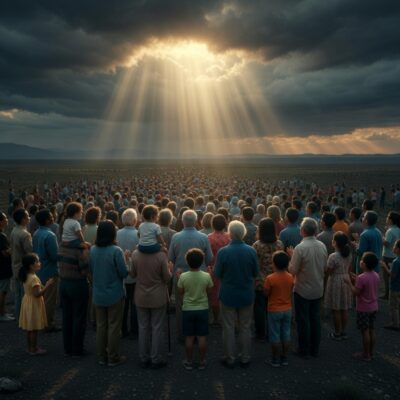
Scripture Reading: John 1:1–13
In the beginning was the Word, and the Word was with God, and the Word was God. He was in the beginning with God. All things were made through Him, and without Him nothing was made that was made. In Him was the life, and the life was the light of men.
And the light shines in the darkness, and the darkness did not comprehend it. There was a man sent from God whose name was John. This man came for witness, to bear witness of the light that all through him might believe. He was not that light, but was sent to bear witness of that light. That was the true light, which gives light to every man coming into the world. He was in the world, and the world was made through him, and the world did not know him. He came to his own, and His own did not receive Him. But as many as received Him, to them He gave the right to become children of God, to those who believe in His name, who were born, not of blood, nor of the will of the flesh, nor of the will of man, but of God.
Let’s seek the Lord’s blessing on this, His Word.
Prayer
Gracious God in heaven, we do praise you and thank you again for your tremendous blessing that you pour out upon us through Christ Jesus. We thank you, especially for the gift that you’ve given to us in your word, that we have it in our language, in our own tongue, that we can read it. And by the power of your spirit, we can have understanding. And so we pray that you would truly bless your word, that as we come to this passage here before us this morning, that your spirit would go forth in power and might, giving us understanding to what the truth that is here, that we might truly apply it to our hearts and our lives, that we would give all praise, glory, and honor to you in all that we do. We pray these things in Jesus’ name, amen.
Jesus as the Word and Light
Well, Jesus is the Word. He is the Word who was with God in the beginning, and He is the Word who was God as the eternal, pre-incarnate Son of God. Through Him and by Him all things were made, and as Creator, Jesus is the source of life that’s given to all creatures, and especially the life given to mankind who alone was created in the image of God.
Jesus is also the light of the world, and He’s come into the world and has been shining in the darkness, and He reveals the reality of the one true living God through all that He created, through the imprint of God’s image on mankind, through the law of God written on the heart of man, that’s man’s conscience, and of course most clearly through God’s special revelation His word revealed to men, to the prophets of old, to John the Baptist who bore witness to Christ’s coming, and through the fullness of the gospel message of all that Jesus did and accomplished for undeserving sinners.
As we’ve seen in our study of John’s prologue thus far, this is the full evidence that God has revealed, both generally to all mankind, but especially to His own covenant people, the descendants of Abraham, Isaac, and Jacob, to Israel, to the Old Testament Church.
The Tragedy of Rejection
But as we considered last time, the great tragedy is that when the true light Jesus came into the world, despite all this evidence, He was rejected. He was rejected by the unbelieving world, the Gentiles, and most tragically, He was rejected by His own people, the Jews, who had, of course, long been waiting for His arrival as the Lord’s Messiah.
But what’s worse, not only did they reject Him, but they put Him to death, even the painful and shameful death of the cross. This is truly tragic.
But the Apostle John doesn’t let this tragedy overshadow the glorious truth that yes, though the true light came into the world and was widely rejected, but His coming into the world wasn’t in vain or of no effect. No, quite the opposite.
The Glorious Reception by the Remnant
For there were many others who did acknowledge Him, who did receive Him, who did welcome Him into their lives. And to these were given a sure and certain hope of eternal life in God’s glorious presence.
This is the truth that John now reveals in the verses before us this morning, showing us who it was that received the light, the result of the reception, and then how it was all made possible in the first place.
John’s Literary Structure
We want to begin first with just a quick note on how John has been structuring his gospel account so far. As we’ve seen before, the apostle often will introduce a thought and then he seemingly steps back to provide a further context.
And so, for example, back in verses 4 and 5, he introduced the word as the light of men. But then later, he offers a fuller, he further elaborates on this light, giving more context in verses 9 through 11, and how that light was received, or in that case, not received.
Now he’ll go on to do the same as well, Lord willing, as we’ll see next time, with his introduction, of course, at the beginning of the Gospel, his introduction of the Word, which was an unnamed entity in verse 1. But then he’s going to come back to that with a fuller understanding and identification in verse 14, when he will tell us that the Word became flesh to all among us.
When it passes before us today, John does the same thing both within verse 12 as well as between verse 12 and verse 13.
So within verse 12 he informs us that many did in fact receive the light. But then he jumps ahead to the result of what happened to those who received the light before stepping back again and going back to further clarify that those who received the light were also those who believed in his name.
And then between verse 12 and 13, John first again in verse 12 presents the idea of who received the light and the results of that reception. But then in verse 13, he steps back again to explain how all this could be even possible again in the first place.
Unpacking Verse 12: Reception and Result
And so with this understanding, we can then unpack these two verses being in verse 12.
But as many as received him, to them he gave the right to become children of God to those who believe in his name.
Now, John informs us here that there were many who received him. That is the true light, even Jesus.
But again, given what’s come just before this in verses 9 through 11, we may ask, well, where did these people come from? Where did these people come from who received him?
Because we know John had presented a very clear and strong case that the light was revealed openly to all and in a whole variety of ways, as we just reviewed.
The truth of God the Creator has been made known and the reality of a Savior and a Redeemer was clearly revealed to God’s covenant people.
And again, such clear evidence was presented and yet the rejection was shockingly widespread. In fact, as John writes, If he didn’t go on to include verses 12 and 13 here, well, we would be left thinking that everyone had rejected the light, even every single person, even the whole world.
But this clearly wasn’t the case. Many, indeed, we can even say with confidence, the majority did reject him. But that rejection wasn’t full and total and all-encompassing.
Because there was a group who did receive Him. A small portion, a remnant, who received Him.
Now, certainly in comparison to the whole, this remnant would have been quite small. But even in reality, it can rightly be characterized, as John says here, many. And that many can even be an innumerable amount who welcomed the light that has come into the world that even continues even to the present day.
The Biblical Theme of the Remnant
Now this idea of a remnant is one that’s found throughout the Scriptures.
- In Genesis chapter 7 we have the account of the flood covering the whole earth and wiping out every living thing. But a remnant is preserved of both man and beast within the ark. They’re preserved by God.
- Later, sin and idolatry plagued the land so much that God’s judgment came upon His own people, the nation of Israel, and it was divided into two kingdoms, with ten of the twelve original tribes separating into the wicked northern kingdom of Israel. But there was a remnant that was preserved in the southern nation of Judah all for the sake of David and the covenant promises that God had made to him.
- Later, Elijah, the prophet, believed that he alone was left of the faithful in all of Israel, but God assured him that there was a remnant of 7,000 had not yet worshipped Baal, the false god.
- And then, of course, much later, the nation of Judah would apostatize in great number, turn away, And yet the Lord promised to preserve a remnant and bring that remnant back from the exile.
So God has always preserved a remnant, even within, as we’ve seen with these examples, even within the boundaries of the visible covenant community. They were not all Israel who were of Israel, as Paul declares in Romans 9.
And even more directly in Romans 11 verse 5, he asserts, even so then, at this present time, there is a remnant according to the election of grace. Assuring that there is still yet hope for the Jewish people. As God still has a remnant that He has chosen in Christ Jesus and will draw to Himself over the ages through the proclamation of the Gospel.
And as John implies here though, this remnant isn’t just of God’s covenant people in the Old Testament, or in the New Testament, the Invisible Church for that matter, but there’s a remnant of all mankind, including both Jews and Gentiles.
And we get this from the context of that it was the world, that is, the unbelievers out there who didn’t know the light. And it was His own within the covenant community, even in here, who didn’t receive Him.
It’s this remnant, though, that God preserves. It’s this remnant that John speaks of when he says, as many as received Him.
You had the wider world, you had within the covenant community, By and large they rejected him, but there was a remnant that God had preserved.
What Distinguishes the Remnant: Faith
Now what distinguishes this remnant from the rest? Both the rest of the world and the rest of the visible covenant community? It’s faith.
As John further elaborates on the identity of this remnant in the last part of verse 12, he says, those who receive him are those who believe in his name.
Receiving Him and believing Him are essentially two ways to say the same thing.
When we believe in Jesus, we receive Him for who He is. The very Son of God. The One who came as the Lamb of God to take away the sins of the world, including our own. And that by His once for all sacrificial death on the cross, we receive forgiveness of our sins and are now reconciled with God, our Creator.
When we receive these truths, we believe in them, we cling to them by the grace of God as applying even to our own lives, to our own situations, including our own fallen sinful natures. Jesus died for me, for my sins. He did what I could not do because of my sin.
I believe this. I believe it as truth accomplished by Him and graciously applied to me.
But John here is personalizing this truth that I and I trust you believe and receive. Note John says, those who receive Him That is a person. And then those who believe in His name. Again, a person.
And so the truth we believe and trust in for salvation is a person. And that person has a name. Jesus.
The Significance of “His Name”
Now to us, typically when we think about a name, someone’s name, it’s simply a label, right? A way that we can identify one another.
But in ancient times, a person’s name was really representative of their whole person, who they are, including their character, their traits, and even their works, that is the things that they do.
And of course this is especially true of the Lord God Himself. Remember that God has chosen to reveal Himself, His person, in His name. Remember when He appeared to Moses from the burning bush and He said that I will reveal to you My name, I am that I am, Jehovah or Yahweh.
And so when we’re called to praise the name of the Lord, for example, in Psalm 69 verse 30, I will praise the name of God with a song and will magnify Him with thanksgiving. When we praise the name of God, we’re actually praising God Himself. No, we’re not just praising a label that simply identifies Him. His name represents Himself.
Well, likewise, in the New Testament, When Peter preaches before the Jewish council in Acts chapter 4, he summarizes who Jesus truly is, even the promised Messiah, God’s own Son. And then he boldly declares,
Nor is there salvation in any other, for there is no other name under heaven given among men by which we must be saved.
The name Jesus represents all who he is. In fact, Jesus, the name Jesus means God’s salvation, right? The angel told Joseph that you will call his name Jesus because he will save his people from their sins.
And so Jesus’ name represents all that he is and what he accomplished as a redeemer and savior of his people.
And so it’s the true remnant of God that has received Christ and believed in Him and believed in His name for salvation.
The Result: The Right to Become Children of God
Well, this then brings us to the result of this reception and faith in Jesus, who is the Word, who is the true light that has come into the world. And we see this here in the middle of verse 12.
John says, to them, He gave the right to become children of God.
So we have those who believe in Christ become children of God.
Now this is not generally, as they already are children of God in a general sense via the creator-creature relationship. But John is speaking here very particularly and specially that they become children through faith in Jesus Christ.
God is our Father. And we’re His most beloved children. And this is truly a great honor.
John would later write in his first letter, 1 John 3, he says,
Behold what manner of love the Father has bestowed on us, that we should be called children of God.
And that behold is just like, just imagine this. It’s unimaginable. Behold this great love that God has for us. That we should even be called children of God.
And so we are beloved children of God, we’re greatly loved, we’re provided for, we’re cared for, we’re protected, we’re nourished and encouraged by the creator of the whole entire universe.
And those who rejected him, both of the world and of his own, well, they don’t enjoy this great privilege.
And we receive this privilege through adoption. Westminster Shorter Catechism Question and Answer 34 says that adoption is an act of God’s free grace, whereby we are received into the number and have a right to all the privileges of the sons of God.
And these privileges include being, as the Apostle Paul declares in Romans 8, 17, heirs of God and joint heirs with Christ.
And so because we’re children of God, we then have a right now, as an heir, to an eternal inheritance. Because we’re children of God through adoption, through faith in Jesus Christ.
And what a rich and wonderful blessing this is.
Becoming Children: Adoption and Transformation
But John’s choice of words here is quite interesting. When he says that we become children of God, As we just noted, this certainly includes adoption and what we might call and refer to the legal rights and the privileges which it secures, like the right to that internal inheritance.
But it also carries with it a sense of transformation.
And so, for example, the Apostle Paul boldly declares in Romans 8.16 that by adoption we are children of God. But John tells us here that we’re given the right to become children of God.
Now the difference is very subtle. You see, Paul is emphasizing status. What we legally are in Christ. We’re children or sons.
But John is speaking of the change with a transformation of status. What we become in Christ.
And the implication is, if we become something, if we become children in Christ, well, the implication is, we were something different before.
And so John, even here, is beginning to point us to what we’ll soon consider regeneration, and the new birth. There’s a change and a transformation that’s going to take place.
For example, in Ephesians 2 verse 3, Paul says that formerly, outside of Christ, we were by nature, not children of God, but children of wrath.
But now in Christ, John is saying that we’re transformed into something new. We’re becoming a new creation.
We’re given the right and the privilege to become children of God. Becoming children of God, then, is a result of our being regenerated by the very grace of God.
How This Is Possible: By God’s Gift
Now, how can we know that it’s by the grace of God and not by some other… Not by some other means, like our own works or our own efforts.
Because again, John makes it abundantly clear, even here, with two little words. He gave.
That is, God gave sinful man the right to become his own beloved children.
We don’t choose to become children of God. It is a right and a privilege that God freely and graciously gives to those who receive Christ and believe in His name.
Now, how can this be? How can we go from sinner to beloved children? How can those who are dead in sins and transgressions even believe and receive Christ, let alone be given this wonderful right and privilege?
Verse 13: The New Birth Explained
Again, John now steps back once again in verse 13. And he’s going to fill in some of the gaps to help us understand how all this was accomplished. And it begins with what we just mentioned before, the new birth, or regeneration.
Note first of all, that in verse 12 and 13, John is speaking about the same group of people.
Those who have graciously been given the right to become, to be transformed into the children of God, are those who have received the word, the light, and believed in His name. Even Jesus.
So how did they come to believe and receive Him? What is it that then distinguishes this remnant, marked by faith, from the larger group? That is, from those in the world and those in the broader covenant community that rejected Him?
Well, John simply states here, they were born.
Now you might think, well wait, weren’t they all born? Even all the people in the world, both Jew and Gentile, even those who reject Him, well, yes, of course they were born.
But the birth John speaks of here, and again, as he’ll make very clear, and as Jesus will even elaborate on further when we get to John 3 and His conversation with Nicodemus, is that the birth that He speaks of is a spiritual birth, and not physical.
the new birth, the second birth, regeneration, however you want to call it, is a gracious work of the Holy Spirit in that that which was dead spiritually has now been made alive spiritually.
Spiritual Death and the Need for Regeneration
Now, we remember that spiritual death, as well as, in fact, physical death, was the curse of sin. God had warned Adam in the garden that he must not eat of the tree of knowledge of good and evil. Why? Because in the day that you eat of it, you shall surely die.
That was, he was telling them very clear. There’s going to be a punishment if you eat from this tree, if you disobey, if you sin against me.
But of course, in sin and rebellion against God, this is precisely what Adam did. Thus bringing the curse of death upon all creation and especially and particularly bringing spiritual death on man in particular.
So that all who are descended from Adam through ordinary generation are now born with the guilt of Adam’s sin.
As Adam’s sin is imputed to us because Adam was our representative before God in the covenant of works there in the garden. When God said to him, you know, don’t eat of this tree, that was his, I’m making a covenant with you. Adam was our representative as the first human being created by God. When Adam fell, we all fell.
And so his guilt is imputed to us, or is put into our account. That’s the accounting term.
Well, because of this fallen condition, We’re born in sin, and we come forth from the womb speaking lies. Even the things that we do that are righteous from a purely human perspective are nothing but filthy rags in His sight.
Paul sums it up in Ephesians 2 that we’re dead in sins and transgressions, and again, that by nature we are children of wrath.
And so a change is needed then. If we’re dead, we must be made alive.
And so the big question is, how does a dead man become alive?
Can he do it himself? No, he’s dead. Can another human being do it for him? Well, some people like to think that it might be possible in the future with advances in science and technology, but it’s never going to happen. And so it will remain a dream of science fiction.
Besides, if a dead man can’t make himself alive, well how could a dead man possibly make someone else alive?
So there must be some outside agency, some miraculous wonder that takes place. And indeed there is. The new birth or regeneration.
Anticipating Nicodemus (John 3)
And so this then becomes John’s argument. How can we be born again, regenerated, and made alive? By what means or agency?
And what John writes here really anticipates the question that Nicodemus raises in John 3 verse 4, when Nicodemus says, how can a man be born when he is old? Can he enter a second time into his mother’s womb and be born?
Now this was a response to Jesus saying in the verse before that, Moses, surely I say to you, unless one is born again, he cannot see the kingdom of God.
And so Nicodemus is struggling to understand what Jesus is saying here because he’s thinking only materially or physically.
And indeed, we know there are physical and material means to bring about life. But John, or excuse me, Jesus in John 3 and John here in chapter 1, verse 13, are speaking of a spiritual birth, not physical.
In fact, John, in part, here is setting forth kind of a polemic against the Jews, who placed their hope and trust in salvation, not in God or faith in His Son, Jesus Christ. But they are replacing all their hope for salvation in their physical bloodline and ancestry, boasting that they’re children of Abraham.
But we know John has already revealed something new and better. Because the one who believes in Jesus becomes not only a child of Abraham by faith, and Paul later acknowledges that in Galatians, but more importantly, you become a true child of God with all the rights and privileges of sonship. So we’re not just children of Abraham, we’re children of God and beloved children of God.
Three Denials: Not of Human Origin
And so John lays out In order to demonstrate this, he lays out three denials. That is, three ways that this new birth isn’t a result of.
First, these ones who’ve received the light and believed in His name, and thus graciously have been given the right to become children of God, were able to do so not because they were born of blood. That is not because of their ancestry, their national, racial identity, or family heritage.
No, again, this was the false hope and trust of the Jews. They prided themselves on being God’s chosen people and children of Abraham. Yet, when the covenant promises that God made to Abraham, Their father, their acclaimed father, when those promises came to their fullness in the person and work of the Lord Jesus Christ, what did they do? They rejected Him, and they put Him to death, revealing that they weren’t truly of Israel. Their bloodline and their family connections meant nothing.
Now, beloved God, this really becomes a great danger even for us today, in the New Covenant community of God’s people, the church.
And I want to challenge us to never think, never think that you’re safe and secure because your parents are Christians. Or because you were born into a Christian family. Or because you may have a long heritage of ancestors who were faithful Christians walking with Christ.
Certainly all these things are a tremendous blessing and we ought to rejoice and give thanks for such a heritage. But these things ought not to be the source of our eternal hope and salvation.
No, our salvation rests in God’s grace and the person and work of Jesus Christ alone. Never lose sight of this. Always, always keep your eyes fixed on Jesus.
But John continues with the denials. He said, These ones who have received the light and believed in His name, and thus graciously have been given the right to become children of God, they were able to do so not because they were born of the will of the flesh.
And here John is using flesh not in a negative sinful sense, but simply in the material sense of just natural physical desires and drives.
And basically he’s saying a husband and a wife can’t simply decide, hey, we’re going to create and bring forth a child of God through natural procreation. It doesn’t work that way.
Yes, it’s through such desires that children are born physically. But again, as Jesus will explain to Nicodemus in John 3, 6, that which is born of the flesh is flesh. But that which is born of the Spirit is spirit.
The transforming birth that’s necessary for salvation is spiritual, not physical.
And then finally, the third denial. These ones who’ve received the light and believed in His name, and thus graciously have been given the right to become children of God, they were able to do so not because they were born of the will of man.
Now here we should note that John doesn’t use the general word for man, anthropos, but it’s more specific, the male or the husband.
So that there’s absolutely nothing a husband can do in order to produce a child of God. It’s completely out of his hands.
And so when we apply this generally, John is indicating that the new birth has nothing at all to do with any human activity, will, or volition.
Not of bloodlines, ancestry, or family heritage. Not of the natural, physical, procreative act. Not even of the determination of sinfully proud man who is dead in his sins, and yet who believes that he can do whatever he wants.
No. There’s only one way. We can be born again.
And if we would carry the thought throughout, and it’s implied here, We’re born not of the will of the flesh, not of the will of man, but we’re only born by the will of God through the work of the Holy Spirit.
The Glorious Truth of the Gospel
Beloved God, this is the glorious truth of the gospel. Indeed, it’s one of the many things that actually makes the gospel good news.
that those who were dead in sins and transgressions, who were by nature children of wrath and deserving of God’s just judgment, and yet Paul affirms in Ephesians 2, 4, 5, that God
This is how you were dead in sins and transgressions. You were children by nature, children of wrath. But God, who was rich in mercy because of his great love with which he loved us, even when we were dead in trespasses, made us alive together with Christ. By grace, you have been saved.
The wonderful truth that John is revealing here in these verses is that though that many rejected the true light, even Jesus, salvation is a full and complete gift that God graciously gives to this remnant by His grace so that those who were born again and who are regenerated by the Holy Spirit of the Living God are the same ones who are enabled to receive the light and believe in His name and are thereby the ones privileged to be given the right to become children of God.
Salvation is of the Lord alone. all to the glory of God alone.
Closing Prayer
Let’s pray.
Oh gracious God in heaven we do rejoice and give thanks for your word and the challenge set before us and we who profess your name and profess faith in your name are truly humbled as we consider our former condition in sin, our natural condition.
And yet, by the outpouring of Your grace and the work of Your Spirit in us, we have been graciously made alive in Christ Jesus, enabling us to receive Him, to believe to be given now the right, the great privilege to be your most beloved children.
Father, we praise you and thank you for such a wonderful salvation. That it’s all of you so that you alone receive the glory and the honor and the praise. We have no reason to boast. we boast in what you have done for us
and father we pray that you would truly by your spirit be active even in our midst now applying these truths to each of our hearts that you would draw us to these truths and applying them may not know you that we would come to know you to the praise of your glorious name
We praise you and thank you, O God, for these things.
We thank you for our salvation, and we ask that you would continue to lead us and guide us, that we might be faithful witnesses throughout this community, throughout the world, as we strive to be witnesses to this gospel message, that others may join with us in a chorus of praise and thanksgiving, and the wonders of your salvation that you have secured for us in Christ Jesus.
In the name of the Lord Jesus Christ, we pray. Amen.