

Scripture Reading: Luke 13:18–30
And then he said, what is the kingdom of God like? And to what shall I compare it? It is like a mustard seed which a man took and put in his garden, and it grew and became a large tree, and the birds of the air nested in its branches. And again he said, To what shall I liken the kingdom of God? It is like leaven which a woman took and hid in three measures of meal till it was all leavened.
And he went through the cities and villages, teaching and journeying toward Jerusalem. Then one said to him, Lord, are there few who are saved? And he said to them, strive to enter through the narrow gate, for many, I say to you, will seek to enter and will not be able. And once the master of the house has risen up and shut the door, and you begin to stand outside and knock at the door, saying, Lord, Lord, open for us. And he will answer and say to you, I do not know you, where you are from. Then you will begin to say, We ate and drank in your presence, and you taught in our streets. But he will say, I tell you, I do not know you, where you are from. Depart from me, all you workers of iniquity. There will be weeping and gnashing of teeth, when you see Abraham, and Isaac, and Jacob, and all the prophets in the kingdom of God, and you yourselves thrust out. They will come from the east and the west, from the north and the south, and sit down in the kingdom of God. And indeed, there are last who will be first, and there are first who will be last.
Opening Prayer
Gracious God in heaven, we do rejoice and give thanks for, once again, this opportunity to look to your word for our encouragement, for instruction and truth.
And we pray that our hearts will be open and ready to receive the truth of your word as it’s proclaimed, the power of your spirit going forth, bringing about a great and abundant fruit in our hearts that are ready to hear what you have to say to us.
We ask for your blessing now upon your word. In Jesus’ name we pray. Amen.
The Lord’s Supper and the Kingdom
This afternoon we have the great privilege again of celebrating the Lord’s Supper.
Again, I’m always amazed that the Lord’s Supper is just a very simple meal, but it calls us to look back and remember the great gift of salvation that Jesus has given to us when he died on the cross for our sins.
And the elements of the bread and the cup are spiritual symbols of Christ’s body and blood, and as we partake of those elements, we do in a very real way, in a spiritual way, we partake of the blessing and the benefits of Christ’s suffering and His death.
And we do so together in the unity and the fellowship of the people of God as citizens of His eternal kingdom.
The Lord’s Supper not only calls us to look back on the death of Christ, it also enables us to enjoy, even now, a foretaste of the more perfect union and communion that we’ll have with Christ and with one another in the coming consummated kingdom of God, ushered in at the end of the age when Christ returns.
A kingdom which began with Christ’s first appearance.
Two Brief Kingdom Parables
And so in our passage this afternoon, we see Jesus teaching us about this kingdom, how it grows, who it includes, and the great celebration that awaits at the table that the Lord has prepared.
He begins here with two brief kingdom parables.
Typically, we know a parable uses a common illustration to demonstrate a particular point or spiritual truth. And in kingdom parables, Jesus is especially seeking to teach his disciples about the nature of the kingdom of God.
The Parable of the Mustard Seed (v. 19)
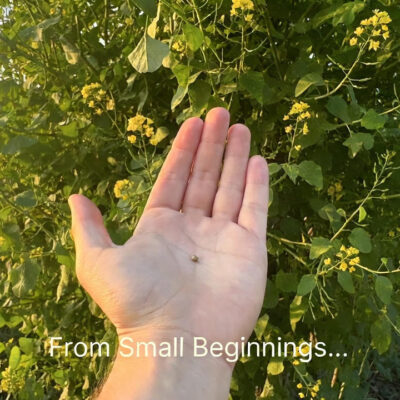
The kingdom of God is like a mustard seed which a man took and put in his garden, and it grew and became a large tree, and the birds of the air nested in its branches.
Now, a mustard seed is very small. It’s a very small seed. But when it’s planted, and of course, when it’s cared for over time, it’ll sprout and it’ll grow until it eventually becomes a large bush in the midst of the garden. And the various birds can come, and they can come and perch on its branches.
And so this is a very basic, simple picture.
But how is the Kingdom of God like the mustard seed and the resulting bush?
The emphasis seems to be on the growth of the kingdom.
Jesus is telling the people that the kingdom of God will begin very small, but it eventually will grow, and it will grow large, and it will spread its branches so far that many will find rest and refuge in it.
And of course, we have the great privilege of being able to look back now on 2,000 years of church history, and we can see the evidence of this very simple truth.
We know that the kingdom of God did begin very small, even with the most humble of beginnings, because its king was born in a stable. And then he later assembled a small band of followers.
And of course, we know that the kingdom may have seemed all but lost when that king was put to death on the cross. But then on the third day, he rose again in victory, and then he empowered his disciples to go forth and to spread the gospel. And this they did.
Within 40 years after Christ’s ascension, we know that the gospel had reached almost every major city within the Roman Empire, and it continued to spread even further.
And even now, we know that the gospel of the kingdom reaches into every continent as it’s stretching toward every people group that there is on the planet.
What started out as a small seed has truly grown to cover the whole earth. And many have found rest and refuge in this kingdom over those 2,000 years.
Jesus emphasizes the outward growth of the kingdom of God through the spread of the gospel with this little parable about the mustard seed.
The Parable of the Leaven (v. 21)
The kingdom of God is like leaven, which a woman took and hid in three measures of meal till it was all leavened.
Now, leaven is simply like basically yeast would be a leavening agent. It’s put in bread dough in order to make the bread rise. And it’s mixed into the dough where it slowly and quietly works its way throughout the entire lump so that every area of the dough is then affected by that leaven, and it begins to increase in size.
Now we know sometimes when leaven is mentioned in the scripture, it has a negative connotation. For example, we know Jesus warns the disciples about the leaven of the scribes and the Pharisees. And basically the warning is that they shouldn’t allow that leaven, the false teaching of the scribes and Pharisees, to spoil their faith.
But here in this parable, leaven is a good thing. It’s describing the kingdom of God.
And again, it begins small and unassuming, but slowly and quietly it spreads until every area is touched.
This can speak of the outward growth in the kingdom of God, similar to the mustard seed, where it slowly and quietly envelops the entire world until it reaches that point of perfection where it’s reached all it’s going to reach, which of course then will be the time for Christ’s return when that happens.
But another way to consider this parable is not so much focused on the outward growth that it brings about, but really the emphasis is on the inward growth.
That is, in the individual as well as in the church and within the kingdom.
That is, as there is outward growth, that you would have numbers of people who come into the kingdom who are being saved and who believed. But then there also should be inward growth of those people who come in and within the body of believers as a whole.
And so we know as believers in Christ, we should continue to grow until every area of our lives is in full and perfect subjection to Jesus Christ and his will.
Again, this is something that won’t be achieved immediately. But as we daily grow in grace and knowledge of the truth, as the Spirit of God in us strengthens us and causes us to grow until we are filled up to all the fullness of God, as Paul mentions in Ephesians 3, until we’re perfect and we’re complete citizens of God’s glorious kingdom.
Then is the kingdom of God working pervasively in us and bringing us individually and as the people of God into a state of perfected completion.
These parables, as Jesus gives them to his disciples, would have been a great encouragement to the disciples, especially after Jesus is taken from them and ascends to heaven.
They’d be encouraged that though their labors for the kingdom would seem small and insignificant at first, that God would work great and mighty things in and through them.
And even though in their own lives they would have daily struggles with sin that would seem to set them back and that within the church there would be divisions and conflicts, yet they could all still be encouraged.
Even as Paul encouraged the Philippian believers in Philippians 1, being confident of this very thing, that he who has begun a good work in you will complete it until the day of Jesus Christ.
And so, brothers and sisters, let this be our encouragement as well.
That the kingdom of God would continue to grow in us and through us, knowing that Jesus hasn’t forsaken the work of His hands. But he continues to stretch and grow us as he uses us to spread the gospel of the kingdom.
The Question: “Lord, are there few who are saved?” (v. 23)
This teaching apparently raises a question about who was to be included in this ever-growing kingdom.
And so someone asks in verse 23, Lord, are there few who are saved?
Now, we don’t know. There’s likely some time that has passed from when Jesus told these parables to this question. And we don’t know whether the question was spurred by the parables or whether it was just completely unrelated.
But it’s possible that someone misunderstood the parables and focused on the smallness of the mustard seed and the unassuming quality of the leaven, and so they wondered whether only a few people would be saved.
But Jesus doesn’t directly answer the question.
Strive to Enter the Narrow Gate (v. 24–27)
Jesus says in verse 24, strive to enter through the narrow gate.
For many, I say to you, will seek to enter and will not be able.
You see, the issue that Jesus is raising here isn’t worrying about how many are getting in or who is and who isn’t getting in, but rather more pointedly, be sure that you’re striving to enter into the door of the kingdom of God.
Everyone needs to be mindful of their own spiritual condition. Where do you stand even now? Inside or outside of the kingdom of God? Are you striving to enter in or are you putting it off until some other time?
He says, strive to enter through the narrow gate.
Again, the fact that the gate is narrow implies that it’s going to be a challenge to get in. And again, this is reinforced by the word for strive, which literally refers to exerting great energy in struggle against an opponent. And from the Greek word, we get our English word agony.
And so it’s an agonizing struggle to enter in through the narrow gate. It isn’t easy. There’s much cost to consider. Our pride is at stake. Our selfishness, our thoughts and desires, and even our lives must come under subjection to the will of God.
It’d be much easier to take the broad way through the broad gate following everyone else. But we know that way leads to destruction. Only the narrow gate leads to life in the kingdom.
Now this striving isn’t a salvation based on works. We don’t want to get the wrong idea here. It’s not at all.
It’s only because of the grace of God that first works in us by the power of the spirit that we can even desire, let alone strive to enter in through the narrow gate. We can’t and we won’t strive to enter in unless Christ strengthens us by His Spirit.
Once our hearts are renewed, though, and revived by grace through faith in Christ, only then can we wrestle against our own sinful nature and the temptations of the evil one with any hope of victory.
And this is exactly what we’re to do, even as Paul charges in Philippians 2, work out your own salvation with fear and trembling, for it is God who works in you, both to will and to do for his good pleasure.
Because God is at work in us, those who now strive in faith to get in will indeed get in.
The Door Will Be Shut (v. 25–28)
But with this challenge, there also comes a great warning.
If you don’t now strive to enter in through the narrow gate, there will soon come a time when it’s going to be too late. A time when many will seek to enter in, but they’ll be unable.
And the reason they’ll be unable is because, as Jesus says here in verse 25, the master of the house, who is Christ himself, will rise up and shut the door.
Jesus is the master. And right now, the door to his kingdom is open for those who strive to enter in by faith. But when Christ returns, the door will be shut.
And those who put off entering in, or who didn’t want to endure the struggle required, or were too busy with the cares and the concerns of this life to enter in, when the door was open, they’re suddenly going to be on the outside looking in.
And Jesus describes how they’ll knock feverishly, pleading with Him, Lord, Lord, open for us.
Now ironically, those who didn’t acknowledge Him as Lord in this life are suddenly going to be compelled to confess with their tongues Jesus Christ as Lord. But it’s going to be too late.
Because once the door is shut, it’s not going to be opened again. And Jesus will respond to them, I do not know you, where you are from.
He doesn’t know them because they never knew Him. And they never confessed His name before man. And so at the time of the end, Jesus will deny them entrance into the Kingdom of God.
They’re going to persist. They’re going to say, Lord, surely you do know us. You see, we ate and drank in your presence, and you taught in our streets.
Now friends, we can’t miss how Jesus is speaking directly to those in His midst, as well as to us and to all people everywhere.
Jesus is anticipating that this will be the response of many in the crowd who’ve been following Him. Many who perhaps were present at the feeding of the 5,000, or who were there in Simon’s house, or in other places where Jesus had eaten a meal, or many who lived in the towns and the villages where He came to preach, to teach, and to heal.
And they’ve been witnesses to all these things. They will be the ones, though, who will be shut out. And they’re gonna be surprised on that day because they believe that these outward associations with Jesus would be enough to allow them entrance.
But Jesus says, no, you’ll be shut out because though you had ample opportunity, you never believed.
And the point Jesus is here making to us is that there will be many who will have such loose affiliations with Him.
Perhaps they went to church as a child. Perhaps they did good works. Perhaps they even now still associate themselves as Christians, and yet they never believed in His name. They never turned from their sins, and they never trusted in Christ alone for salvation.
These are the ones who will be locked out of the kingdom.
But this final rejection by Jesus is much more severe than just being locked out. Jesus again in verse 27 says He doesn’t know them and He calls them workers of iniquity and He demands that they depart from His presence.
Well where are they going to depart to? The description that Jesus gives in verse 28 is a place of weeping and gnashing of teeth. That’s clearly a reference to the eternal judgment of hell—a place where there’s no consolation or comfort, only great pain and suffering.
And to add to the torment, it appears as though those in hell will have a view of heaven seeing Abraham and Isaac and Jacob and all the prophets in the kingdom of God. But here they are, they’re thrust out, they’re locked out.
Consider how dramatic this would be to the ears of this primarily Jewish audience—his forefathers and the prophets that they persecuted. They’re going to see them there in the kingdom of God, but they themselves are going to be thrust out.
You see, they were trusting in their heritage and in their family associations to gain them entrance into the eternal kingdom. But Jesus warns them and he warns us, these things will not do.
Only by the grace of God through faith in Jesus Christ will you be enabled to enter in and remain in.
But friends, we must enter in while the door is still open. And as the gospel continues to go forth, even now, the door is still yet open. Even today. Consider then your own hearts. For one day it will be too late, and the door to the kingdom will surely be shut.
Many Will Come from Every Direction (v. 29–30)
But Jesus isn’t done with His kingdom teaching. In verse 29, He finally gives, really, a more direct answer to the original question about whether there are just a few who will be saved.
They will come from the east and the west, from the north and the south, and sit down in the kingdom of God.
Though the door is narrow, the gate is narrow, Jesus says that there will actually be many who are saved. And they’re going to come from every direction, as he mentions all the different points of the compass.
This again emphasizes the tremendous growth of the kingdom of God. As the gospel spreads around the globe, just like that mustard seed grew into that great mighty bush in the garden.
And citizens of the kingdom are going to come from all over. And they’re going to celebrate the glory of the kingdom at the table that the Lord Himself has set.
Even as we’ll gather together at the Lord’s table just shortly to celebrate the forgiveness of sins and the salvation that we have through the shed blood of Jesus Christ.
So too will this still future table be established, calling together all God’s people to join Him in celebrating in the consummation and the perfection of His kingdom.
But as Jesus goes on to note in verse 30, there’ll be some surprises at that table.
Indeed, there are last who will be first, and there are first who will be last.
In the context here, it seems that Jesus is perhaps more focused again on his current audience as he’s traveling throughout the various towns and cities of Israel. He’s talking primarily to these Jewish people.
You see, the Jews have been given first priority. To them belong the law and the promises of God’s covenant.
But with the explosive growth of the Kingdom of God through the Gospel, the Gospel is going to spread rapidly beyond the Jewish people.
So that those who are coming from East and West and North and South to recline at the table aren’t just the highly privileged Jews who believe in Christ, but also the Gentiles.
And so the expanse and the growth of the Kingdom includes the Gentiles, those who once were outsiders.
And as Paul describes in Ephesians 2, who are without Christ, being aliens from the commonwealth of Israel and strangers from the covenants of promise, having no hope and without God in the world. And yet now they, and even we, have been brought near by the blood of Christ.
And we are blessed guests at His table—both the table set before us now, but more importantly, the glorious table of the kingdom to come.
Certainly this is great reason for us to celebrate.
But we must be reminded, though, of that warning. We must, by God’s grace through faith, strive to enter in through the narrow door that He has opened.
A door that God, in His abounding patience, continues to keep open, even now for those who believe the gospel.
But friends, don’t delay. Because a day is surely coming when that door will be shut. And when it’s shut, it’s not going to be opened again.
To believe then on Jesus Christ, even now, and enter into God’s kingdom and celebrate with Him at His table, both now at this time of His glorious, and at the time of His glorious return to the glory of God alone.
Closing Prayer
O gracious God and heavenly Father, we do rejoice and give thanks for your encouragement to us, and the challenge presented in your word, that now is the time to strive to enter into the gate of the kingdom.
Relying fully upon your grace, trusting in you, trusting in what Christ has done for us—His sacrifice for our sins.
That we strive to enter in and to live our lives filled with gratitude, seeking to glorify you. Striving to be sanctified and purified until that day when we are perfected in the image of Christ Jesus, when He returns in power and glory at the end of the age.
Father, we just rejoice and give thanks that you have so blessed us, that you have given us this simple meal, which we’re about to partake, that causes us to look back on what Christ has done, but also points us forward to something glorious yet to come.
You are so good to us. And we praise you and thank you for it.
And we pray that each and every one here would be even now drawn to you, closely to you, that we would strive to enter in in true faith and sincerity, all to the praise of your glorious name.
In the name of the Lord Jesus Christ, we pray. Amen.