

Acts chapter 3, verses 11 through 19. This passage contains Peter’s second sermon, though we are covering only the first half tonight; Lord willing we will consider the rest next time.
Scripture Reading
Now as the lame man who was healed held on to Peter and John, all the people ran together to them in the porch, which is called Solomon’s, greatly amazed. So when Peter saw it, he responded to the people, men of Israel, why do you marvel at this? Or why look so intently at us as though by our own power of godliness, or godliness, we have made this man walk? The God of Abraham, Isaac, and Jacob, the God of our fathers, glorified His servant, Jesus, whom He delivered up and denied in the presence of Pilate, when He was determined to let him go. But you denied the Holy One and the Just, and asked for a murderer to be granted to you, and killed the Prince of Life, whom God raised from the dead, of which we are witnesses. and His name, through faith in His name, has made this man strong, whom you see and know. Yes, the faith which comes through Him has given Him this perfect soundness in the presence of you all. Yet now, brethren, I know that you did it in ignorance, as did also your rulers. But those things which God foretold by the mouth of all the prophets, that the Christ would suffer, He has thus fulfilled. Repent, therefore, and be converted, that your sins may be blotted out, so that times of refreshing may come from the presence of the Lord.
Opening Prayer
Oh, gracious God and heavenly father, we do rejoice and give thanks for your word. We know it is our only infallible rule for faith and life. And as we come to this passage this evening, we pray that you would lead us and guide us according to your truth, giving us insight all to the praise of your glorious name. And so we ask now for your blessing upon your word in the name of the Lord Jesus Christ. We pray. Amen.
Introduction: Recap of the Healing
Well, the last time we considered the account of Peter and John healing a lame beggar on their way to the temple.
They had no silver or gold to give him, but they gave him what they had, which was certainly much more valuable than any amount of silver or gold.
In the name of Jesus, they healed the man, and the man’s life was changed forever.
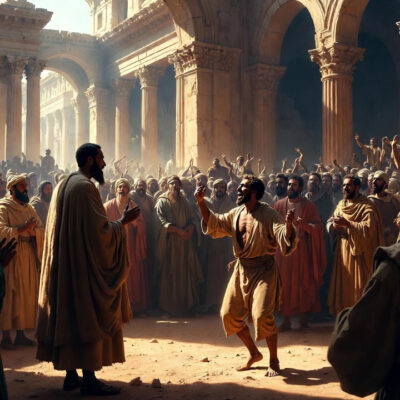
With great excitement, this one, born lame, he leapt up, he danced, and he ran, giving praise to God for what had happened.
Well, the crowds who recognized the man from years of sitting at the gate of the temple were amazed.
And from verse 11, it appears as though the man was clearly identifying Peter and John as those who had healed him. And so with great excitement and amazement, a crowd quickly gathered around.
The Providential Opportunity
In God’s providence, this healing incident and the subsequent amazement by the crowds provides yet another opportunity for the gospel to be proclaimed by the apostles to a large crowd.
But different from Peter’s, during the time at Pentecost, where there were skeptics. Remember the skeptics, at least initially, some were wondering whether the disciples were drunk with wine at an early hour in the morning.
Well, here there don’t seem to be any skeptics, at least not yet.
As most of them knew this man, and again they had seen him day by day, year after year, begging at the temple gate.
And so they’re sincerely curious about how this man that they knew, that they knew to be lame from birth, how did he come to be healed?
And again, we think it hasn’t really been all that long since the ministry of Jesus.
And so again, many in the crowd likely had the ministry of Jesus and all the healing miracles that he performed and all the stories that they heard about him when they would come into the city for the feasts. That was still likely very fresh in all of their memories.
And so they know that Jesus was put to death. So what is going on now with this dramatic healing?
So we can imagine that people were very curious that this had taken place.
Well, as the crowd gathers, Peter and John are ready to, again, seize this opportunity.
And this is really important for us to keep in mind as well, and really somewhat of a challenge for us to always be ready to share the gospel.
We never know when God will provide us with an opportunity. Whether it’s a curious crowd gathered around after hearing of something amazing, or maybe just the interaction with someone at the grocery store.
It’s important to always be ready.
And here Peter quickly learned this, of course, after the situation at Pentecost when there was a crowd who quickly gathered around after they heard all this amazement, all the voices and the rushing wind and people speaking in different languages. the praise and the wonderful works of God.
And so here, Peter once again takes this opportunity.
In fact, he learns from this and he would later challenge future generations of believers, even us today, to do the very same thing.
He writes in 1 Peter 3 saying, always be ready. Take good defense to everyone who asks you for a reason to the hope that is in you with meekness and fear.
And so certainly we should always be ready. We never know when the Lord will present us with a crowd ready to hear the gospel.
Peter’s Method in Preaching
Well, as with his Pentecost sermon, Peter uses kind of a similar method or approach in his sermon. called a sermon, probably technically really wasn’t a sermon, but we refer to it as a sermon, or as his discourse here.
And again, this highlights, so his method highlights the importance of his message, and he arranges it in such a way to make the full impact of the message.
And so his method is simply this.
Peter’s four-part method:
- He gives an explanation as to what happened.
- He demonstrates from the Scriptures how Jesus has now come in fulfillment of the Scriptures.
- He sets forth the guilt of sin.
- He finishes by calling the people to repentance.
1. Explanation: Not by Human Power
First, he explains what has happened here, and he makes clear that it wasn’t by the power of man that brought about this miracle, but it was truly by the power of God, all in the name of Jesus.
In verse 12 he says,
Men of Israel, why do you marvel at this, or why look so intently at us? as though by our own power or godliness we had made this man walk.
So Peter wants the crowd to know right from the start that it wasn’t by his own power.
It wasn’t that this healing took place. It wasn’t something inherent in him or in John.
It wasn’t even in their godliness or in their piety.
But it was solely by the power of God and Jesus Christ.
And in particular, it was the power that was in response to faith that healed this man.
This is what he would say later in verse 16,
And his name, meaning the name of Christ, or the name of Jesus, through faith in his name, has made this man strong, whom you see and know. Yes, the faith which comes through him has given him this perfect soundness in the presence of you all.
And of course, they were reminded of how when Jesus healed people, it was always the common thing he would say to them, your faith has made you well.
And so this was truly a faith healing, a healing in response to not only the faith of the lame beggar who believed in the name of Jesus for healing, but also healing in response to the faith of Peter and John, through whom the power of the Spirit was now working.
And I think last time we talked about that the man expresses his faith when he obeyed the command of Peter to get up and walk.
And he believed that he could do that. And so he did, and he indeed was healed. That was the demonstration of his faith.
And so we know that this teaches us that faith is truly essential to healing.
There’s nothing magical about saying, in the name of Jesus, you are healed, because it must be accompanied by faith.
The Example of the Seven Sons of Sceva
We have an example later in the book of Acts.
The seven sons of Sceva will attempt to imitate the apostles’ words in order to cast out demons.
They see the apostle casting out demons and say, hey, we want to try to do that.
And we’re going to cast you out in the name of Jesus whom Paul preaches.
And if you remember, those demons did not respond so well, and they turned on those seven sons of Sceva and attacked them.
The reason was because they thought that it was just like, this was just a magical spell, right?
As long as they said the right words in the right way, then they would be able to cast out these demons, as Paul did, but they lacked faith.
They had no faith in Jesus, no faith in what the power of God could truly do.
But again, this wasn’t the case.
So we know that faith needs to be present for the one receiving healing as well as for the one doing the healing.
And so truly by faith this man was made whole.
Does Faith Healing Still Happen Today?
So what are we to think then about such faith healing? Does it still happen today?
The Apostle Paul spoke of healing as one of the spiritual gifts given to believers, and though he makes clear in 1 Corinthians 12 that not everyone has this gift, but it was truly a special gift given for extraordinary times, just like the gift of tongues, the gift of prophecy, given for a particular time in order to confirm the message that was being proclaimed as being truly from God.
Now the need of such extraordinary signs passed with the apostles and the close of the New Testament, and so that no one today can truly claim to have the gift of healing.
We do know that God surely does heal.
And sometimes this healing can be miraculous in response to prayers offered up in faith.
And James talks about this in James 5.
He says, those who are sick are told to ask for the elders to come and to pray over them for their healing.
He wouldn’t give those instructions if there was the idea that healing could truly come.
So as we pray in faith, we can expect a response.
A response that we know is always according, though, to God’s most holy and perfect will, and not necessarily ours.
But as we pray in faith, we also pray that our wills will be conformed to God’s will, knowing with full confidence that the answer received will be the perfect answer that would bring ultimate glory to God in that situation.
It may not be the answer that we initially looked for, but it will be the perfect answer that we will receive when we seek the Lord and pray to Him in faith.
And so it’s truly good and right that we would regularly pray for people to be healed.
And we would do well to be even bold in our prayers.
And again, sometimes there’s a counter reaction that we’re oftentimes too shy to be bold in our prayers when we want to pray for somebody for their healing.
We may be afraid that people might think that we’re advocating for that false prosperity gospel and that we’re seeking after gifts that have ceased.
But we ought to be bold in such prayers for healing.
We ought to be bold in all of our prayers, simply for the fact that we don’t know what God’s plan and purpose is.
And so we shouldn’t be afraid that He might actually respond in a way that’s just far too amazing for us to fully comprehend.
And so let’s pray boldly in faith, and we’ll see how the Lord magnifies his name to the answer that we receive.
Important Reminders When Praying for Healing
But there are some things we need to keep in mind when we pray in faith for healing.
We need to remember that if healing does occur, and whether that healing occurs through ordinary means of medicine, or through extraordinary and miraculous means, that such healing is only temporary.
That is, it’s only temporary because unless Jesus returns in our lifetimes, it’s been appointed for each of us that we will someday die. For all of us.
And so being healed does not mean we will escape death.
And this is rather significant even when we think about Lazarus, who was raised from the dead, yet his resurrection was only temporary.
You see, He would once again go the way of all flesh and die and be buried.
But this won’t be in vain.
Because at some point, some glorious point in the future still yet to come, Lazarus will be raised yet again. But this time, for all eternity, when Christ returns at the end of the age.
And so those who preach faith healing and the false prosperity gospel, they need to come to grips with this reality, as we all do, that they all will succumb to the curse of death.
And they will not be able to prevent it.
And there have been a lot of these faith healers Over the years, they’ve kind of come and gone, and many, they get sick.
There’s some prominent ones that have gotten cancer and died from it.
Well, the wife of the guy and all his friends in this false gospel, they all claimed to have this gift. Why didn’t anybody heal him?
Well, maybe he didn’t have enough faith.
And that’s often a great destructive lie that they press on for people as to why they’re not healed is that they don’t have enough faith.
Well, may not simply, just simply may not have been God’s plan and purpose to bring healing to that person.
And that’s what we, the other thing we need to do is that we also need to keep in mind that it may not be God’s plan for us to be healed.
Again, this is another area where the faith healers get wrong.
They falsely proclaim that God only wants everyone to be healthy and wealthy.
Well, the scriptures never speak of such a thing.
Biblical Examples of Unhealed Believers
There’s some significant examples of this, even in the New Testament.
- The Apostle Paul was able to heal people on several occasions, but in Philippians 2, Paul speaks of Epaphroditus and how he was sick, even close to death. And yet, we see nothing noted about Paul attempting to heal him.
- And then in 2 Timothy 4:20, Paul bluntly states, while Trophimus, I left in Miletus sick. Paul left a sick man back. He didn’t take him because he was sick. Well, why didn’t he heal him? It was not God’s purpose for Trophimus to be healed.
- And even Paul himself, we know, was afflicted with some sort of suffering, a thorn in the flesh, as he calls it, in 2 Corinthians 12. And yet, even after praying three times for it to be removed, God never removed it. He never healed him.
And the Lord’s response to Paul regarding this is really a most profound comfort even for us.
My grace is sufficient for you, for my strength is made perfect in weakness.
What a great blessing to know that the grace of God is sufficient for us.
Even in our suffering, God has a purpose. Even it’s to glorify himself in the midst of our weakness.
And so not everyone is healed.
And again, even those who were given the gift to be able to heal others, they weren’t given that power and authority each and every time.
It was all up to the perfect plan and purpose of the sovereign God who gave that gift.
And this is, again, the problem with modern faith healers who believe that they can simply call up the healing power at any time.
It doesn’t work that way. As we see in the New Testament, it clearly never did.
But here, in Acts chapter 3, at this time, on this particular occasion, it was God’s plan.
And it was God’s purpose. That this lame beggar, this man who was born lame, would be healed in response to his faith, in the faith of the apostles.
And so Peter makes that very clear.
2. Jesus: The Promised Servant of the Lord
Well then using this healing and the explanation of how it happened as a springboard, Peter then reminds the people who Jesus was and how he came to fulfill the prophecies of the Old Testament scriptures.
Peter first makes this connection in verse 13 when he says,
The God of Abraham, Isaac, and Jacob, the God of our fathers, glorified his servant, Jesus.
And so this healing took place in the name by the power and the authority of Jesus.
And Peter first makes this connection between the covenant Lord, and he says the God of Abraham, Isaac, and Jacob, and the servant of the Lord, Jesus, who’s now been glorified.
And Peter’s use of the word servant is significant because the servant of the Lord was a clear Old Testament reference to the Messiah or the Christ.
We read earlier in Isaiah 49 verse 5,
and now the Lord says, who formed me from the womb to be his servant. to bring Jacob back to him, so that Israel is gathered to him. For I shall be glorious in the eyes of the Lord, and my God shall be my strength.
This coming servant would be the way to lead Jacob back to the Lord.
And this one shall be glorious before the Lord, and shall be empowered by God, thus enabling him to do great miraculous works of healing.
Another Old Testament passage is, of course, Isaiah 53, where he had that picture of this righteous servant of the Lord as a suffering servant who brings healing to his people by his stripes through his suffering.
So Peter is making the point clear that Jesus is this promised servant of the Lord.
And then he goes on to make this even more clear by using other terms and titles and tying them to Jesus.
For example, in verse 14, he says, the holy one, and the just, or the righteous one, those are messianic titles.
Example in Isaiah 53, verse 11,
he shall see the labor of his soul, and be satisfied by his knowledge, my righteous servant shall justify many, for he shall bear their iniquities.
And here in verse 15, Jesus is referred to as the Prince of Life. That is, he’s the author and the giver of life.
The identification here is clearly that Jesus is the Lord God.
And then in verse 18, he says,
But those things which God foretold by the mouth of all his prophets, that the Christ would suffer, he has thus fulfilled.
Jesus has come to fulfill the Old Testament prophecies.
And even His suffering and death on the cross were in fulfillment of the suffering servant in Isaiah 53.
And here Peter seems to be echoing the words Jesus spoke to the two disciples on the road to Emmaus after His resurrection when He appeared to them in Luke 24.
He says,
These are the words which I spoke to you while I was with you, that all things must be fulfilled which were written in the law of Moses and in the prophets and the Psalms concerning me.
Jesus is clearly the Christ. He’s the Messiah.
And it’s this same Jesus who has now been raised again.
And it’s in His name that this miracle was made possible.
3. The Guilt of the People
Establishing that, then once again makes a transition, and he uses this to then pierce their hearts, as he boldly charges in verse 13,
this Jesus, whom you delivered up and denied in the presence of Pilate, when he was determined to let him go. But you denied the Holy One and the just, and asked for a murderer to be granted to you. and killed the Prince of Life, whom God raised from the dead, of which we are witnesses.
Now talk about speaking directly about someone’s sin.
Peter holds nothing back and clearly charges the death of Jesus to their account.
They not only delivered Him over, but they disowned Him and denied Him and rejected Him as their Messiah.
And on top of that, he was an innocent man.
And Pilate, the Roman governor, found no fault in him. He wanted to let him go.
But the people pressed upon him and demanded that they crucify him.
And then to add to this, they rejected the Prince of Life and cried out for Barabbas who is a murderer and a thief, and we might say a prince of death.
Imagine the shock of this revelation.
Think about it. For hundreds of years, his people have been waiting for the Messiah.
And yet when he does appear, they reject him and they put him to death.
And yet Peter testifies that by eyewitness accounts, He and the other apostles and many others, that this just one still lives.
And he was raised from the dead dead by the power of God.
He still lives and from his heavenly throne, he’s still healing the lame and the sick, and he’s still transforming lives.
The crowd must be sensing a great remorse about now.
And Peter softens the blow, but only just a little bit, in verse 17, and he says,
Yet now, brethren, I know that you did it in ignorance, as did also your rulers.
They were truly guilty, but their sin was a sin of ignorance, because they did not know, because they refused to know. because their hearts were darkened.
4. The Call to Repentance and Hope
And therefore, Peter now leads them to the hope of the gospel through a call to repentance.
In verse 19 he says,
Repent therefore and be converted, that your sins may be blotted out, so that times of refreshing may come from the presence of the Lord.
They had been hoping and dreaming that the Messiah would bring freedom and a time of refreshing.
But they put their Messiah to death. Now what are they to do? Where now is their hope?
Well, Peter assures them that a time of spiritual refreshing is still available.
But this won’t be an earthly political refreshing of which they were expecting. but a refreshing and renewal of the Holy Spirit, and a washing away of sins, indeed, a blotting out of their sins, removed from the record book of God.
And this time of refreshing had now come, and it can be theirs.
If only they would repent, if only they would turn away from their sins. and return to God in faith and believe on the servant of the Lord, the Lord Jesus Christ, the very one that they had put to death not long ago.
And as an example to them, this lame beggar, whom they pass by every day to and from, as they went to and from the temple, there begging by the gate, beautiful, this one, has now experienced this refreshment in a most dramatic way, and it truly has transformed his entire life.
And it’s undeniable, the change.
And Peter offers this same hope to the crowd, even as it’s offered to us today when the gospel is proclaimed.
Application and Conclusion
And so we see that Peter follows this method.
Something happens. He gives this explanation, What happened to this man?
And then he declares, he uses that to declare that Jesus had come as the Messiah and fulfillment of the scriptures.
And then he exposes the guilt of the people and their sin.
But then at the same time, he pierces their hearts. It’s really the spirit that pierces their hearts.
When he offers to them hope, that though they put Jesus to death, there is still hope if they would repent and believe in Him.
Brothers and sisters, this becomes a great challenge for us as well, especially as we remember that we were complicit in the death of Christ as well, because it was our sin which nailed Him to the cross.
It was our sin for which He died, that He took upon Himself.
He bore our guilt, and He endured the wrath and curse of God that only we deserved.
And He did this so that we might become the righteousness of God in Him.
That we would receive His perfect, righteous, holy robes in return.
And that’s what’s being offered to these who are listening to Peter and John in Jerusalem.
And it’s being offered to us even here.
That in Christ and by faith in Him alone, we too have forgiveness.
And that a time of refreshing, both now in this life, but of course more fully in the eternal life to come, is truly coming to the glory of God alone.
Closing Prayer
Gracious God in heaven, we do rejoice and give thanks for your word, for your truth.
And just this message, this dramatic healing that took place and how you guide your apostles to use it as an opportunity to be ready to proclaim the gospel and the glory of the gospel that it truly sets forth.
that this one who was put to death, that he now lives because he rose again from the dead and he sits now at the right hand of God the Father, where he continues to do mighty works and wonders.
He continues to bring healing, to grant forgiveness, to bring true refreshment. and to totally transform lives.
Those who are lost, to those who are now found.
Those who were dead in sin, to those who are now alive in Christ.
Those who are in prison, to those who are free.
Father, we just praise you and thank you for this, the truth of your gospel.
And it is a great and wonderful treasure.
And may we hold it, fast and cling to it and may it ever be on our hearts and our minds and on our lips and that you would lead us even to those who are in need of that refreshment that the gospel offers and that you would work in their hearts even as you worked in our hearts all to the praise of your glorious name we pray all these things in the name of the Lord Jesus Christ, amen.