

Outline
I. Jesus Enters the Holy Place — and Finds a Marketplace
After a brief stop in Capernaum, Jesus journeys up to Jerusalem for Passover, the great memorial of God’s deliverance. But where he expects reverent prayer, he meets the stench and noise of a stockyard auction inside his Father’s house.
II. The Innovation That Felt Like a Good Idea
The temple markets began as convenience — letting weary pilgrims buy certified sacrifices and exchange currency on arrival. Yet every man-made addition to God’s worship runs the same course: it swells until it consumes and replaces what God himself commanded.
III. Convenience Curdles Into Corruption
What started as service became a cornered market of price-gouging, priestly kickbacks, and Gentiles crowded out of the only court left to them. The holy ground where God symbolically dwelt was defiled by greed, and worship was traded for the best deal.
IV. The Whip in the Hand of the Holy One
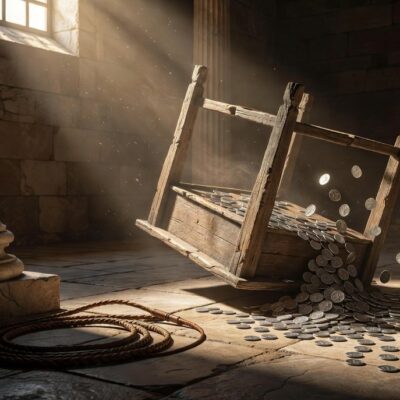
This is no weak, mild-mannered Jesus — in righteous anger he braids a whip, drives out the animals, and overturns the tables. Like the fire that struck Nadab and Abihu, his zeal declares that the holy God must be regarded as holy, and approached as such.
V. “My Father’s House” — The Authority Behind the Anger
In a single phrase Jesus claims God as his own Father, asserting the authority of the only begotten Son to cleanse his own house. The cleansing itself is the sign of who he is — yet the leaders, complicit and hard-hearted, demand proof rather than repent.
VI. The Zeal That Will Cost Him His Life
The disciples recall the prophecy, “Zeal for your house has eaten me up” — the same consuming zeal for God’s holiness that will carry Jesus to the cross. The Messiah comes not with gentle soap and water but as a refiner’s fire, and that fire foreshadows judgment on the temple itself in A.D. 70.
VII. Turning the Whip on Your Own Heart
We are not Jesus, and the answer is not to smash the coffee shop and overturn the tables of the modern church. The harder, holier call is to let his refining fire purge the sin and self-styled innovation within us, cultivating a zeal to worship in spirit and truth.
Bottom line:God is holy — so come to worship not with your own clever innovations but on his terms, trusting Christ alone to refine and carry your worship into the Father’s presence.
Scripture Reading
Once again, listen now to the reading of God’s holy word.
After this he went down to Capernaum, he, his mother, his brothers, and his disciples, and they did not stay there many days. Now the Passover of the Jews was at hand, and Jesus went up to Jerusalem. And he found in the temple those who sold oxen and sheep and doves and the money changers doing business. When he had made a whip of cords, he drove them all out of the temple with the sheep and the oxen and poured out the changers’ money and overturned the tables. And he said to those who sold doves, take these things away. Do not make my father’s house a house of merchandise. Then the disciples remembered that it was written, zeal for your house has eaten me up.
Opening Prayer
Let’s seek the Lord’s blessing on this, His Word.
O gracious God in heaven, we do praise You and thank You for all Your abundant mercies and goodness and Your grace that You pour out upon us. We thank You again for the opportunity that we have to gather for worship. We thank You for the gift that You’ve given to us in Your Word. It is our only infallible rule for faith and life.
And so as we come to this passage this morning, we pray that you would, especially by your Spirit, give us understanding and insight to the truth that is here, that your Spirit would apply it to our hearts, and that it would be our great fruit, all for your glory. And so we ask now for your blessing upon your Word. In the name of the Lord Jesus Christ, we pray. Amen.
Introduction
Jesus’ miracle of turning water into wine in Cana at the wedding really marked the inauguration of His public ministry. And the first sign that was only known, we remember, to a select few was the beginning of the revelation of His glory as the Son of God. And as we’ve noted from the beginning of our study of John’s Gospel, this revelation is really the key theme that the apostle emphasizes in this gospel account. And there are eight of these miracles or signs, nine if you want to include Jesus’ own resurrection, that John highlights to prove his point, revealing this glory of Jesus as the Son of God.
But we also know that Jesus revealed His glory and His true identity, not just through the many miracles that He performed, but also in His teaching and preaching and even in His actions and interactions with others that weren’t necessarily miraculous. And we catch a glimpse of this in our passage here this morning. In this account of Jesus cleansing the temple, we see the revelation of his authority as the Son of God to say and to do things that only one sent from God could do. But not only does this become a great stumbling block for the Jewish religious leaders, but it also teaches us a very important lesson about God, about his holiness, and how we ought to approach him in worship, even as Christians in the church today.
The Journey to Capernaum
And we begin with a point of transition here in verse 12. After this, that is, after the wedding in Cana, he went down to Capernaum, he, his mother, his brothers, and his disciples, and they did not stay there many days. So Cana, remember, was kind of in more of the hill country of Galilee, and Capernaum was along the coast of the Sea of Galilee.
And it’s interesting to note here, though, who is traveling with Jesus at this point. We know that the disciples had gone with him from the region of Judah, the Judean wilderness, where John had been baptized, and they traveled up to Cana, and now they’re joined by his mother and his brothers. And again, it seems to be that these, all we know that Jesus’ mother was there at the wedding and as well as the disciples, it’s likely that the brothers were also there at the wedding. But now they’re heading to Capernaum instead of Nazareth, which we know to be Jesus’ hometown, or at least the place where he grew up.
Now, there’s some speculation that perhaps at this point Jesus, Mary, and his brothers had maybe moved to Capernaum from Nazareth after Joseph’s death, but we don’t really have any way of knowing any of that. It truly is just speculation. But we do know that for much of Jesus’ public ministry, Capernaum became really his home base, and of course the place of many of the miracles that he did, as well as much of the teaching that he did in the synagogues.
The Brothers of Jesus
Now, by his brothers, we should understand this really in just a plain sense of the words. These were Jesus’ brothers or half-brothers who were born to Mary and Joseph after Jesus’ miraculous birth. And so I want to point out there’s really no biblical or theological warrant to support the superstitious claim that Mary remained a perpetual virgin and that these were somehow his cousins, or they were his older half-brothers born to Joseph from a previous marriage. If they were older brothers, they certainly wouldn’t be now following Mary all around, because we know Jesus is at least 30 years old at this point. And so the word for brothers here is specifically brothers. It doesn’t mean relatives. It’s just brothers.
Jesus’ brothers are named for us in Mark chapter 6:
- James, who wrote the book of James
- Judas, or Jude, who wrote the book of Jude
- Simon
So at least four brothers, and we know also that he had some sisters. Well, remember, though, at this time that his brothers didn’t believe in him. It seems as though they didn’t believe in him until after his resurrection. Yet it seems as though here, at least early on at this point, they were kind of part of this entourage, this crowd that followed Jesus, at least in the early part of his ministry.
And so this group of people, this group of them, Jesus, his mother, his brothers, his disciples, they all travel from Cana to Capernaum. They’re there for a short time before they hit the road once again and they’re traveling. Now it’s possible that during this time that they’re in Capernaum, as we see in the other gospel accounts, that Jesus then gathers to himself the rest of his disciples. He already has about six of them at this point. We know from what John has recorded, John doesn’t really record the calling of the other disciples. And so that likely perhaps happens during this time, which fills out the 12 who would become known as Jesus’ closest followers.
The Passover Feast
Then in verse 13, we’re told that the Passover of the Jews was at hand, and so Jesus then went up to Jerusalem. Now this is, again, a helpful time marker. We know that John is very good about placing these different time markers, and so the mention of the Passover tells us that these events — going back to the testimony of John the Baptist about Jesus, the beginning of Jesus gathering his disciples and the wedding at Cana — that these all likely took place in late winter, early spring, because the Passover typically was celebrated in either March or April.
Passover was one of the three great feasts of the Jews when all males age 20 and over were to go to Jerusalem to take part in the celebration and offer the designated sacrifices and whatever other parts of the feast rituals that they would do. And the Passover we remember was the feast that was held in remembrance of the Exodus and God’s deliverance of his people from slavery in Egypt.
The Origin of the Passover
And this Passover was first instituted under Moses in connection with the tenth and final plague that the Lord had brought upon the Egyptians. And remember with that plague that the Lord had said after Pharaoh had repeatedly hardened his heart, refusing to let the people of God go? And so the Lord brought this one last plague where he would send the angel of the Lord throughout the land and it would take the lives of the firstborn, of all those in Egypt. But the Lord had instructed Moses to tell the Israelites to slaughter a lamb and sprinkle its blood on the doorposts of their homes so that when this angel of death came, that it would pass over those homes who were marked with blood. And so, hence the word Passover.
And again, there’s a lot of imagery in this. This judgment and the subsequent deliverance that it led to was then remembered each year by the sacrifice of the lamb without blemish and a meal of roasted lamb, unleavened bread, and bitter herbs, again, as reminders of God’s great salvation secured and the flight from Egypt.
The Passover as a Picture of Christ
Well, the Passover really is in the Old Testament, is the great salvation event that we see in the Old Testament. And so it stands then ultimately as a picture of this greater salvation to come that Jesus himself would usher in. Jesus as the Lamb of God who takes away the sin of the world and that by his sacrificial death would provide atonement and forgiveness of sins and deliverance from the bondage of sin and death for those who believe. And so the curse of sin and death will pass over those who’ve been covered by the blood of the Lord Jesus Christ. And that is a great and wonderful blessing that we even now enjoy.
Well, we know that the end of Jesus’ ministry that he will make this very clear connection that he has come in fulfillment of the Passover meal when he institutes the Lord’s Supper at the close of that Passover meal. And again, the Lord’s Supper being a special meal that we now celebrate according to Christ’s institution as a reminder and remembrance of that perfect salvation that he has secured for us.
Well, another thing to note about the Passover, especially in John’s Gospel, is that there are three Passovers mentioned in John’s Gospel. And so this indicates to us the time frame of Jesus’ public ministry. It’s how we know that Jesus ministered for just about three years. And so this is the first mention here in Chapter 2. But with each subsequent reference, we see that Jesus is brought closer to the fulfillment of that feast, which pointed forward to Him and to His securing of a greater salvation for us.
Jesus Enters the Holy Place — and Finds a Marketplace
And so, Jesus and His disciples are now on their way to Jerusalem to celebrate this Passover feast. But as Jesus enters the temple to worship God in preparation for this celebratory feast, instead of reverent praises and prayers being lifted up to the Lord by faithful worshipers, He’s met instead with the stench and bleating sounds of a stockyard sale and a marketplace.
Verse 14, he found in the temple those who sold oxen and sheep and doves and the money changers doing business.
And so the place of worship had become a place for buying and selling.
The Temple Was a Holy Place
Remember though, the temple was a holy place. The temple had been dedicated to the Lord as the place that he symbolically dwelt in the midst of his people. This was the very place of God’s own choosing. He had set it apart as holy. Even as we remember when Solomon first built the temple, at least the first temple, and dedicated how the Shekinah glory cloud of God descended upon the first temple, symbolizing to the people that the Holy God was dwelling in their midst. It was truly God’s house.
And even though Solomon wisely confessed, 1 Kings 8, saying,
but will God indeed dwell on the earth? Behold, heaven of heavens cannot contain you, how much less this temple which I have built.
So Solomon knew already that this was God’s symbolic dwelling place. That it was too restrictive. It could not contain God in the fullness of His glory. Not even all the earth. Not even all the heavens and the earth can contain the glory of God. But as a blessing to His people, God had this cloud descend upon the temple to reassure them that he truly was with them. And so that place then, at that time, became a holy place because of the presence of God. But this holy house had now been turned into a marketplace.
The Innovation That Felt Like a Good Idea
And we may wonder, well, how could this have happened? Well, as with many of the traditions of the elders, it very likely began as a well-intentioned idea. I mean, think about it. Many of the Jewish pilgrims, not all the Jews live right there in Jerusalem or in Judea. After the dispersion, they came from all over the Mediterranean region. And so for some, it would take several weeks for them to get to Jerusalem in time for the feast. We see the Apostle Paul and Acts experiencing that very thing where he’s already in Corinth and he’s like, hey, I got to get back to Jerusalem in time for the feast.
And so they’re traveling all these miles, all these great distances to attend the Passover. But the challenge was that with each feast there were sacrifices that were required. And so you can imagine the added challenge of not only traveling these hundreds of miles to go to Jerusalem, but then you also had to take along the required sacrifice. A bull, a goat, a lamb, doves or pigeons, whatever was required. And so it became quite convenient for those, for these out-of-town pilgrims, to just kind of come unhindered and purchase the required sacrifice once they got there to Jerusalem.
Now, of course, an added benefit is that since all the animals were gathered here in the temple of the courts, it was then easier for the priests to examine and even perhaps pre-certify them so that they would be acceptable sacrifices according to the law. We know that there were various regulations that it had to be an animal without blemish, as often was required. And so again, you can imagine these pilgrims traveling a long distance and they’ve got their animals in tow. But once they arrive there in Jerusalem and they present their animals to the priests, they realize they don’t meet the standard and so they’re rejected. And so then what do they do?
And so it seems as though this arrangement of having these markets there in the courts of the temple was a good solution. The people could simply purchase the required animal right in the temple court and present it right to the priest, knowing with confidence that it was going to be acceptable. No problems. Indeed, even the money changers provided a very much needed service. Pilgrims, again coming from far away places, could exchange their foreign currency for the Tyrian coins, which were required for the payment of the annual temple tax. And these coins were used because of their superior silver content. And so it was this convenient one-stop shopping for all your Passover needs, right there in this market, there in the courts of the temple.
When Innovation Takes Over
It seems like a great idea. But as with any innovation man introduces into the worship of God, these innovations eventually take over and consume any thoughts of a good idea or even they consume what God has explicitly commanded and replace what God has explicitly commanded. And so instead of place for reverent worship of the most holy God, the temple was turned into a bustling marketplace. Our thoughts were more on getting the best deal than preparing for the worship of God in spirit and in truth.
And it’s interesting to note that obviously all the courts of the temple were designated and the most general, as you got closer, to the most holy place, the courts got more restrictive:
| Court (outermost → innermost) | Who could enter |
|---|---|
| Court of the Gentiles | The outside court — open to all |
| Court of Women | |
| Court of Israel | The men |
| The Holy Place (the sanctuary) | |
| The Most Holy Place | Only the high priest, one day a year on the Day of Atonement |
And so it seems as though maybe one of the consequences here, obviously everybody could gather in the court of Gentiles. And so you had this marketplace set up in the court of the Gentiles. Well, what does that say to the Gentiles? Where are they going to worship? There’s very little room for the Gentiles, for the proselyte who had come to believe in the God of Israel. And so there almost was maybe perhaps a stigma with this as well, where they were preventing people from truly worshiping God.
Convenience Curdles Into Corruption
Well, not only this, but we know that this innovation would open wide the doors for corruption, which then would only further defile the holy grounds of the temple. Because these vendors and money changers, with their access to the temple, well, they really had kind of cornered the market. And thus, they could easily manipulate the prices for their own advantage. And since their presence had to be approved by the priests, well, it is most certain that the priests received a portion of the profits of these sales. And so they were also benefiting. And so this was the corruption.
And it’s likely in response to these things, this corruption, the greed of the priests and the merchants, but especially the defilement of the holy dwelling place of the Lord, that Jesus reacts in the way that he does in verse 15 and 16.
He made a whip of cords. He drove them all out of the temple with the sheep and the oxen and poured out the changers’ money, overturned the table. He said to those who sold doves, take these things away. Do not make my father’s house a house of merchandise.
The Whip in the Hand of the Holy One
Now, reading this, Jesus’ actions here can be quite shocking, especially shocking, maybe not so much to us, but shocking to those who are unfamiliar with the Scriptures and with the seriousness with which God takes His holiness. Indeed, too many people, even many Christian people, they have this picture of Jesus as weak and mild mannered and non-confrontational. But we remember Jesus as the word who was in the beginning with God and who was God and who even now reigns as the God-man over all creation is most holy. He is most just and righteous and with a great zeal for his holiness and the holiness of the heavenly father.
We know that Jesus confronted people. He boldly called out sin and condemned it. He exposed lies, deceit, and corruption. And here, in righteous anger, He purges God’s holy house of these animals and merchants, even using a whip, because God is holy and He ought to be regarded and approached and worshiped as such.
A Mild Cleansing Compared to the Last
And here, Jesus, we know because there’s another, there’s two temple cleansing, one here at the beginning of His ministry, the other just the last week before His death. And here, compared, this cleansing compared to that one is kind of mild. His rebuke here is mild compared to when he cleanses the temple just days before his death. Because there he condemns them not just as merchandisers, but as a den of thieves and robbers. Likely because they didn’t heed this rebuke that is issued here in chapter 2 of John, the first time when Jesus cleansed the temple. They just picked up after he left and continued to do these things.
The Example of Nadab and Abihu
Well, Jesus’ emphasis is clearly on the disregard for the holiness of God and His house. And such disregard, whenever we see it in the scriptures, we know is always confronted with a very severe response. And I’ll just give one example. Consider Nadab and Abihu in Leviticus 10, perhaps a familiar example that we know well. His sons of Aaron are immediately struck down before the Lord because they offered profane fire to the Lord. That is, they offered incense that the Lord did not command them. Obviously, Aaron would be greatly grieved, but Moses intervenes and he reminds Aaron in verse 3, this is what the Lord spoke, saying,
By those who come near me, I must be regarded as holy. And before all the people, I must be glorified.
Nadab and Abihu did not regard God’s holiness, and they paid a severe penalty. Jesus, again, kind of being even, even though it’s drastic, it seems kind of radical for the common understanding of who Jesus is, and it’s really mild compared to what he did to Nadab and Abihu, but it’s the same God.
The temple is a holy place, and it’s built on a holy land, but not because of any intrinsic value in the actual location of the real estate. And it’s not because of the materials that were used in building the temple that makes it holy. No, it was holy only because the presence of God dwelt there. It was a place of prayer and worship. It was not to be a place to buy and sell, and certainly not a place to advance greed and theft and interfere with people’s desire to worship God. Jesus cleanses the temple of these animals, the merchants and money changers, because they had no regard for the holy presence of God in the temple courts.
“My Father’s House” — The Authority Behind the Anger
So what’s the significance of this dramatic incident? What’s given here for our instruction? Well, there are several things that we can glean.
First, in relation to Jesus, we discover a further self-revelation of who he truly is. Especially in this incident, we see the revelation of his authority as the only begotten Son of God. We see this in his rebuke to the dove merchants in verse 16, when he says, do not make my father’s house a house of merchandise. Jesus refers to God in a very real and personal way as his father. And we know that later the Jews, Jesus would make this referral, called God his father, and the Jews took great offense because they believed he was blaspheming, because if you’re claiming to be the son of God, well then you’re claiming to be God himself.
And that’s what Jesus is saying here. This is my father’s house. He could just as easily have said, this is my house. And yet they have filled it with merchandise. This was also, the very idea was confirmed by the baptism of Jesus as John the baptizer testifies about the voice from heaven, that this is my beloved son in whom I am well pleased. Jesus acknowledges that He is the Son of the Father. And as the only begotten Son of the Father, Jesus is God become flesh. And therefore, He has the authority to purge and cleanse His appointed place of worship. He has the authority to clean His own house.
The Sign They Refused to See
In fact, as we’ll consider, Lord willing, next time, it’s this issue of authority that really becomes the key stumbling block for the religious leaders. Because they don’t necessarily, it’s interesting, they don’t necessarily complain about what Jesus did. Right? Possibly implying their complicit guilt in the corruption of the temple courts. But really their chief complaint is in connection with Jesus’ authority to do such a thing. In fact, as we’ll see, they make a connection to the authority of the Messiah. They would acknowledge that, well, this would be something that the Messiah would do. And so, because of that, they demand from Jesus a sign to prove that He has this authority. That He has the authority as the Messiah or as a prophet sent from God.
But the thing is, Jesus has already given them a sign. He’s cleansed the temple of these merchandisers, something that they as the priests should have done. They should have understood the corruption and the misuse of God’s holy place. But they allowed it because they are profiting from it. And they had no regard for the holiness of God. And as we’ll see throughout His public ministry, Jesus clearly reveals who He is. Yet the people only harden their hearts and they continue to reject him.
The Zeal That Will Cost Him His Life
Another significance of this event is confirmation of the truth of God’s word as prophetic words about the coming Messiah given long ago are now coming to fulfillment. And we see this first in the impression this incident has on the disciples. As they recall, verse 17,
then his disciples remembered that it was written, zeal for your house has eaten me up.
And this is a quote from Psalm 69, verse 9. And in the context of Psalm 69, as we’ll see here shortly, in that context, David is being assaulted by his enemies. No surprise there. And his enemies are falsely accusing him. But it’s all because he’s consumed with zeal for the Lord’s house. That is, he’s striving to live righteously, and yet the enemies are relentless in their attacks. But it’s interesting because it seems as though they’re attacking David not because of anything David has done, per se, but it’s because of the very fact that he is the Lord’s anointed.
And so he concludes, at the second part of verse 9, verse 9 is,
the zeal for your house has eaten me up, and the reproaches of those who reproach you have fallen on me.
And so that’s what David was experiencing, that they were hating God. They were hating that he was God’s anointed. And so they’re reproaching him. They’re persecuting him because they can’t attack God, obviously. So they attack his anointed one.
David as the Prophetic Mouthpiece of Christ
But we know here, clearly, David is the prophetic mouthpiece of the Lord Jesus Christ. And in fact, throughout this psalm, there’s many references. Psalm 69, it’s one of the six psalms that are most quoted in the New Testament. And much of it, where Psalm 69 is quoted, has to do with Christ’s suffering and death, even when He’s there on the cross. But even here, when He’s cleansing the temple, that the zeal for God’s house has consumed him.
And so this is the very experience of Jesus Christ. His great zeal for God’s holiness, we know is ultimately what leads to his death on the cross, right? He is repeatedly condemning the scribes and the Pharisees, the religious leaders for their corruptions of God, of God’s law. And because of that, even though these enemies of God professed to know God. They were the religious leaders. They were the ones who should have known the law and should have understood these things. But their hearts were very far from Him. And ultimately, we know that they despised God in favor of their own self-righteousness and their man-made traditions. And so this incident of cleansing the temple is in fulfillment of the scriptures, that Jesus is the righteous one consumed with zeal for God’s holiness and his house.
The Refiner’s Fire — A Prophecy from Malachi
A third significance is found for the Jewish religious leaders, and the connection here is to yet another prophecy fulfilled. And this time from the prophet Malachi, Malachi chapter three, the first three verses. And now this is the same passage in Malachi that speaks of the coming of John the Baptist. And we looked at that several weeks ago, or a couple months ago at this point. Malachi, though, declares not only the messenger who will prepare the way of the Lord, but he declares that there’s another messenger who is the Lord’s Messiah. He says,
and the Lord whom you seek, meaning they’re looking for the Messiah, the Lord whom you seek will suddenly come to his temple. Even the messenger of the covenant, that’s the Messiah, in whom ye delight. Behold, he is coming, says the Lord of hosts. But who can endure the day of his coming? And who can stand when he appears? For he is like a refiner’s fire and like launderer’s soap. He will sit as a refiner and a purifier of silver. He will purify the sons of Levi, the priesthood, and purge them as gold and silver, that they may offer to the Lord an offering in righteousness.
And so this is a warning. And Malachi is giving this warning that though the people will be anxiously awaiting the Messiah, and that when Jesus arrived on the scene, they were awaiting the Messiah. There was this messianic excitement, and we’ve talked before about that. But when he actually does arrive, Malachi warns, he’s gonna come swiftly and with great authority. And he’ll begin to purify the temple and its worship, and even the priests and the worshipers will be purified.
But this purification and refining process involves heat and flames. In other words, it’s not just going to be a gentle washing and cleansing with soap and water. He does mention the launderer’s soap, but he also mentions the refiner’s fire, which turned up to a great heat to melt these precious metals so they can be cleansed and purged of their impurities. And so it’s not going to be a gentle washing and cleansing. It’s going to be a burning away with fire of the corruptions and the defilements.
Now, I wouldn’t recommend this, but if you happen to touch fire, it hurts. It burns. And that’s what Malachi is warning. They’re expecting the Messiah to come. Hey, this is going to be great. But he’s saying, it’s going to be a little bit different than you expect. He’s going to come with fire to purge and to cleanse. And of course, this purging and cleansing includes the traditions of the elders and the innovations of man that have been introduced into the worship of the most holy God. Whatever he hasn’t commanded, will be burned away.
Judgment on the Temple
Now, we touched on this briefly last time with the passing away of the old and the ushering in of the new, that Jesus is bringing reformation to the worship of God, even as he will bring reformation and renewal to those who believe in him, purifying and transforming them into a new creation. But for the priests and for the religious leaders and those who follow them, Jesus’ actions here are a stark warning of a greater and more severe judgment to come, even the ultimate destruction of the temple and Jerusalem in 70 A.D. by the Romans. And this judgment will ultimately finalize what Christ will accomplish at the cross. The doing away of the temple system altogether and the ushering in of the new, more glorious and more personal dwelling place of the Lord — the church of Jesus Christ.
Turning the Whip on Your Own Heart
And speaking of the church, this dramatic event has great significance for the church today. Now, sadly, you don’t have to look too far to see the various innovations of man that have crept into much of the church and the worship of God. And certainly some of these may have entered with good intentions, but as you go around and you observe, it seems that others seem to be more purposefully bent on conforming the church to the world rather than striving to help the church seek to conform the world to Christ. But regardless of how they’ve entered, whether with good intention or evil intention, they all run the very same course, and they eventually take over and consume the simple worship of God in spirit and truth that God commands in His Word.
What Would Jesus Do?
And so, what are we to do in such cases? What is here for us in this passage to consider? Well, several years ago, and I have to track down and see if I can find it, I saw a little cartoon. It certainly would be a meme today. But in this little cartoon, there was a man who was standing in the middle of a bookstore or a coffee shop inside of a church. And there was the man inside the coffee shop, and then you had the pastor and others who were looking at this man in great disbelief, as the shelves and the tables were overturned in that shop and the coffee pots were smashed on the floor all around him. And the caption underneath read, I just asked myself, what would Jesus do?
Well, as tempting as it may be to take up the role of an iconoclast and start turning over tables and destroying things, we must remember that we’re not Jesus, the perfect Son of God. And we can’t and we shouldn’t do all that Jesus did.
A Holy Zeal Within
But friends, we can in our own space, but especially we can in our own hearts and lives. We can work in God’s grace at purging all the sin and the corruption that defiles. Indeed, we ought to, each one of us, develop a holy zeal for the things of God, especially for his worship, as we would commit ourselves in the grace of God to humbly come before him each Lord’s day, seeking to worship in spirit and in truth. That is under the guidance of the Holy Spirit and the truth of God’s word, according to the truth of God’s word, knowing with all confidence that Jesus, our great high priest, is going to mediate our worship, and he’s going to purify it, and he’s going to strip it away from all imperfections so that it reaches up to God the Father in the heavenly places, all to the praise and glory of his name alone.
Closing Prayer
Let’s pray.
O gracious God and heavenly Father, we do rejoice and give thanks for this important reminder that you are a most holy God. And though you are, we don’t have to go to a particular building and on a particular hill in a particular city in some far away place in the world to go to worship you. But you now dwell in the midst of your people who believe you and who trust in you, who gather together in your name. That even now you are here with us. And because of that, this is a holy place. That this is a time of acknowledging your holiness.
And we pray, Lord, that our hearts would truly be right and humbled to acknowledge your holiness. To not be presumptive about how we would approach you. To not come up and be innovative of different ways that we might think would be good ideas of how we can worship You. No, we desire to worship You in spirit and in truth, guided by Your Holy Spirit according to the truth of Your revealed will in Your Word. We can worship You is the most holy God.
And we praise you and thank you that you have given us such a great honor and privilege to do that even this day. And we thank you that it is because of the Lord Jesus Christ and all that he has accomplished for us, that we can approach your holy presence, even now in the heavenly places, with great boldness and confidence, because we are wrapped in those holy and perfect robes of our precious Savior, Jesus.
And so we just praise you and thank you, O God. And we pray that we would never lose sight of this, that when we gather together on the Lord’s Day, we’re here to worship the most holy God, and that we would have our hearts ready and prepared for such worship. And we just praise you and thank you for this time of worship that we’re having right now. And we pray that our hearts are truly prepared and that you would truly minister in our hearts by your spirit, applying these truths to us, drawing us all closer to yourself, all to the praise of your glorious name. In the name of the Lord Jesus Christ, we pray. Amen.