

Scripture Reading: Exodus 20:4–6
You shall not make for yourself a carved image, any likeness of anything that is in heaven above, or that is in the earth beneath, or that is in the water under the earth. You shall not bow down to them, nor serve them. For I, the Lord your God, am a jealous God, visiting the iniquity of the fathers upon the children to the third and fourth generations of those who hate me, but showing mercy to thousands to those who love me and keep my commandments.
Scripture Reading: Deuteronomy 12:29–32
When the Lord your God cuts off from before you the nations which you go to dispossess, and you displace them and dwell in their land, take heed to yourself that you are not ensnared to follow them after they are destroyed from before you, and that you do not inquire after their gods, saying, How did these nations serve their gods? I also will do likewise. You shall not worship the Lord your God in that way. For every abomination to the Lord which he hates, they have done to their gods. For they burn even their sons and daughters in the fire to their gods. Whatever I command you, be careful to observe it. You shall not add to it, nor take away from it.
Opening Prayer
O Gracious God and Heavenly Father, we do rejoice and give thanks for the truth of your word that it reveals to us that it is our only infallible rule for faith and life, and we are so thankful that you have been pleased to give us your word that we might know more about you, that we might know about ourselves, our purpose, and how we are to serve and glorify you. And especially as we consider this morning, how we are to worship you. We just pray that you would lead us and guide us and bless us with your word this morning through the ministry of your word. And as it goes forth in the power of the spirit, we pray that we truly find within each of our hearts that rich fertile soil that brings about great and abundant fruit for your glory. In the name of the Lord Jesus Christ we pray, Amen.
Introduction to the Second Commandment
In the first commandment we were reminded that there is only one living and true God and that this God is our Creator, our Redeemer and our Covenant Lord. As his creatures uniquely created in his image, we know that we are required to know and acknowledge God as such, and give our worship to and to glorify him alone in our lives.
If this is the truth, and according to God’s word, we know it is, then it ought not to surprise us that God would have something to say to us and even require of us as to how we are to approach Him in worship. Yet it seems as though very few stop to ask, how does God want us to worship Him? Has He given us any instructions or commands in His Word about what He desires in our services of worship?
Instead of asking these kinds of questions, many seem to think that God just doesn’t really care about how we worship Him, as long as we are sincere. It is deemed completely acceptable to worship God according to our desires, to our preferences, to our imaginations, rather than anything God might command in His Word.
As we come to the second commandment this morning, we see that God has indeed something to say to us, not only about how we ought to approach Him in worship, but what we should do in our worship that is most pleasing to Him.
Whenever we gather together as we are here now on the Lord’s Day to worship God as one body in Christ Jesus, we must always strive to only worship God as He has commanded us in His Word. This is what we often refer to as the Regulative Principle of Worship. The Regulative Principle of Worship is rooted in the second commandment of God’s moral law.
God’s Commands Regarding Worship Are Rooted in His Holiness
Before we consider the biblical foundation of this principle, we must first consider the truth that God’s commands regarding worship are rooted in His own character, especially in His attribute of holiness.
God’s holiness refers to His perfect purity, that is, without stain and without blemish. It also refers to His being set apart from all other beings in all of creation. God’s holiness is related to His infinite majesty, to His glory, and to His magnificence that far surpasses that that any of His creatures may possess. Ethically, it means that God is completely separated from all evil and sin.
God is not just holy, but He is most holy. As we see the angels crying out in Isaiah’s heavenly vision in Isaiah 6, He is holy, holy, holy. That is to say He is holy to the nth degree. There is no one who is as holy as God.
This acknowledgement of God’s holiness is right here in the second commandment, and the reason that God gives for this commandment. In verse 5 He says:
For I, the Lord your God, am a jealous God.
God is a jealous God. The Lord makes this even more clear in Exodus 34, where He declares that His very name is Jealous.
How is God jealous? He is jealous for His holiness. He is jealous for His desire that no one else would receive the glory, the honor, and the praise and the worship that He alone deserves. This is not irrational. Because God alone is the one true living God. There is no other. He alone is worthy. He alone is perfectly holy.
Whenever we offend him or give worship to someone or something else, we are actually assaulting God’s holiness because we are taking away from him what rightly belongs to him alone and giving it to another.
This means that we just cannot approach Him in worship any way that we want. We must be careful to respect the holiness of God.
The Example of Nadab and Abihu (Leviticus 10)
This is highlighted in the scriptures in a most dramatic way in Leviticus chapter 10 with the account of Aaron’s sons, Nadab and Abihu.
Just before this, in the first nine chapters of Leviticus, the Lord through Moses had given especially the priests detailed instructions about how they are to approach him in worship: the required sacrifices, the ritual cleansings, and all this detail.
Nadab and Abihu are dramatically struck down by the very hand of God because they dared to offer profane fire to the Lord. The fire offered was profane or unholy because the Lord had not commanded them to worship Him that way. They took it upon themselves to offer to God something He did not command. They added to what God had commanded.
This was a direct violation of the regulative principle of worship and of what God commanded in the second commandment.
Nadab and Abihu thought they had a better way to worship God. But it was profane fire, and the Lord struck them down.
Why did God respond so severely? Because they assaulted the holiness of God. Moses says to the grieving Aaron:
This is what the Lord spoke, saying, By those who come near me, I must be regarded as holy. And before all the people, I must be glorified.
God takes His holiness seriously. Nadab and Abihu did not regard God as holy, and they paid severely for it.
This incident stands as a warning to us even today. God will hold us accountable if we assault His holiness.
Because God is holy, we must be careful to regard him as holy, especially when we approach his presence in corporate worship.
Our worship is not to be informed by:
- good intentions and well-meaning traditions
- false and idolatrous traditions that God clearly forbids
- what seems right to us, what we like, what our preferences are
- the supposed blowing of the spirit (presuming we are led by the Holy Spirit when we are actually led by our own desires)
Only what God has revealed to us in his word—our only infallible rule for faith and life—must guide us.
The Clearest Statement of the Regulative Principle: Deuteronomy 12:32
Whatever I command you, be careful to observe it. You shall not add to it nor take away from it.
In Deuteronomy 12, Moses reviews the law before Israel enters the promised land. He warns them not to imitate or even inquire about the worship practices of the conquered nations.
Great detail had already been given about how the people are to worship God (latter Exodus, Leviticus, parts of Numbers). There is to be no other way but how God had commanded them.
- No adding to what God has commanded (no innovations, as Nadab and Abihu did)
- No taking away from what God has commanded
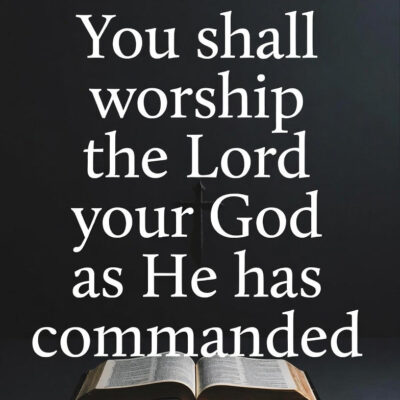
God is to be worshipped only as He has commanded.
The Principle Continues in the New Testament
The principle is upheld throughout the New Testament and applies to the church today because God and His holiness have not changed.
L
At the close of the canon (Revelation 22:18–19):
For I testify to everyone who hears the words of the prophecy of this book. If anyone adds to these things, God will add to him the plagues that are written in this book. And if anyone takes away from the words of the book of this prophecy, God shall take away his part from the book of life, from the holy city, and from the things which are written in this book.
Jesus upholds it:
If you love Me, keep My commandments. (John 14:15)
Jesus with the Samaritan woman (John 4:23–24):
But the hour is coming, and now is, when the true worshipers will worship the Father in spirit and in truth, for the Father is seeking such to worship Him. God is spirit, and those who worship Him must worship in spirit and in truth.
True worship is led by the Spirit according to the truth that God has revealed in His Word—no innovations of man.
What Has God Commanded Regarding Worship?
General Commands and Principles
- Worship God alone (First Commandment; Matthew 4:10)
- Worship with reverence, awe, and respect (Psalm 95:6; Malachi 1:6)
- Not just outward posture but true humble condition of the heart
- Worship in an orderly, structured way — not with chaos or frenzy (1 Corinthians 14:33, 40)
- Worship on the appointed day (Fourth Commandment — the Lord’s Day)
- Worship through the one mediator, the man Christ Jesus (Ephesians 2:18)
Specific Elements God Requires in Corporate Worship
These elements provide our liturgy (order of service) and assure decency and order:
- Prayer with thanksgiving (invocation, pastoral prayer, prayers before/after the Word, benediction)
- Reading, preaching, and hearing of God’s Word
- Singing of praise to God (Westminster Confession 21.5: singing of psalms with grace in the heart — exclusive psalmody, a cappella)
- Proper administration of the sacraments (baptism and the Lord’s Supper)
- Receiving of tithes, offerings, and gifts
Nothing is added. Nothing is taken away.
What the Second Commandment Forbids
1. The Use of Images in Worship
You shall not make for yourself a carved image, or any likeness of anything that is in heaven above, or that is in the earth beneath, or that is in the water under the earth. You shall not bow down to them, nor serve them.
This forbids images of:
- false gods
- or representations of the one true God (including all persons of the Trinity)
Scripture gives no physical description of God or of Jesus. Any attempt to depict Jesus inevitably leads to idolatry (seen in Roman Catholicism, Eastern Orthodoxy, and many Protestant settings).
2. Will-Worship or Self-Imposed Religion (Colossians 2:20–23)
Traditions and rules of men, even if well-intentioned, have no place in the worship of God. They may have an appearance of wisdom but are worthless.
The second commandment forbids worshiping God in any way He has not prescribed or appointed in His Word:
- not with images
- not with incense or ceremonial rituals fulfilled in Christ
- not with animal sacrifices
- not with instruments that accompanied those sacrifices
- not with uninspired hymns
- not with bitterness, hypocrisy, pride, or deceitful hearts
Conclusion
Beloved of God, our worship of the Most Holy God, the God who is holy, holy, holy, is to be offered in accordance with His revealed will.
As we submit our desires, ideas, likes, preferences, and imaginations to His Word, guided by the Holy Spirit in the name of Jesus, we will come to see the beauty and the glory of the simple worship that God desires from us.
Casting away all the traditions, trappings, and imaginations of man, the simple worship offered with true and sincere hearts is truly what brings all glory, honor, and praise to the one true living God alone, because He alone is worthy.
Closing Prayer
O gracious God in heaven, we do rejoice and give thanks for this important reminder regarding the second commandment and its application to us today and how it informs our worship. Lord, we know that even as we strive to do things according to your word we fall short in a variety of ways. Yet we pray that you would continue to lead us and guide us.
As we look to You, as we look to Your Spirit, as we look to Your Word, help our worship to be that true, sincere, simple worship that You desire—offered and guided by the Holy Spirit according to the truth of Your Holy Word. Because it is in that simplicity that you are most glorified, that the focus is all on you.
It is not about us—our entertainment, our enjoyment. It is about acknowledging our creator, desiring to know him, and approaching him with humble regard to your holiness, that you are most holy, while acknowledging our own unworthiness and unholiness.
Yet we rejoice and give thanks that we are privileged to boldly enter into your most holy presence because we are wrapped in those holy and perfect righteous robes of Christ Jesus, our Savior, who took upon himself our sin and in exchange gave us his righteousness.
What a great privilege and an honor this is. Holy, holy, holy is the Lord God of hosts. May we seek to glorify and magnify your name in our time of worship together. In the name of the Lord Jesus Christ, we pray. Amen.